Saturday, April 19, 2008

The Commandment With A Promise

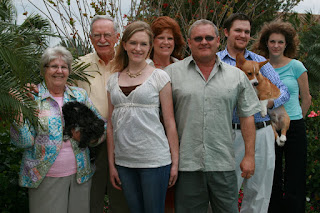
It's that time of the year when high school seniors start to hear whether they have been accepted by this or that university. My granddaughter Cassie just returned from a trip to Boston with her parents. She has been accepted by M.I.T. and is excited about what the next years of her education hold for her. She sent me an email, saying she'd be posting her Boston photos on Facebook soon. In addition, she sent a family photo taken in their back yard during the recent Easter holiday. 

Of course, I made the photo my computer's desktop display. Now every time I open up, I see my daughter Cheryl, her husband Derrick, Cassie, her brother Shawn and his fiance Marian, all standing with Sylvia and me, smiling. I studied their faces, particularly the noses. Cassie has a nose just like her mother's and Shawn has one like Sylvia's. I couldn't locate anyone with one quite like my own hang-down type. 

All that got me thinking about family and the way the Lord God has ordered life on this earth. That also jibed well with my meditation one morning last week on Jesus' comments about honoring one's parents in Matthew 15 and again in Matthew 19. He referenced the commandment given through Moses in the days of the Exodus, "Honor your father and your mother, so that you may live long in the land the LORD your God is giving you." The command was repeated shortly before the Children of Israel entered the promised land: "Honor your father and your mother, as the LORD your God has commanded you, so that you may live long and that it may go well with you in the land the LORD your God is giving you."

As has often been noted, this is the first commandment with a promise: "that you may live long in the land the LORD your God is giving you." Like many, I've often wondered what the promise means? Does it mean that we'll each receive the blessing of a long life if we honor and respect our parents? If so, it does not seem to work out. I know many who so honored their parents and yet died long before old age. What then? 

I believe there are several clues to the meaning hidden in the text. The first is in the pronoun you. It is a plural pronoun. Consequently it refers to the entire people, not to each individual. It refers to the lifestyle and customs of the people. If they treasure and hold parenthood and family in high regard, the LORD will smile upon them. 

The land was the land given to them by God's promise. Specifically it referred to that area we since have learned to call the Holy Land, stretching from Egypt to Damascus. The Hebrew has two words for land, eretz and adamah. In the case of this commandment, the word adamah is used. Adamah refers to land that is arable, farming land. Since Israel's was primarily an agricultural culture, the promise had to do with God's blessings upon their vineyards, olive orchards, grain fields and the like. 

Finally, the blessing has to do with living in this land described in the Bible as good and spacious, flowing with milk and honey. If they respected this command along with the other commands and teachings given to them, they would continue to live and prosper in this land. The LORD of the covenant, the One who had rescued and redeemed them from bondage and slavery, would bless them over the years. 

It is a good and important lesson, one we do well to learn wherever we may be. This has especially to do with those of us who have accepted the Good News of Jesus Christ, risen from the dead. He is that LORD of whom the commandment speaks. He has set us aside to honor Him in the land where He has called us to be. In the United States that no longer refers to a land whose economy is based upon agriculture. Nor is ours a rural life. We are predominantly an urban culture. Yet in this land we continue to marry and have children. 

The LORD's blessings rests upon this fundamental institution. I will not lay out the complete details of this teaching. Suffice it to say there are several vital implications for us in our day. 

Marriage is the union of one man and one woman. There is no other definition in God's Word. It can never be redefined as the union of two men or two women or any other combination. 

Children are to be brought up in such a family. It is not always possible. The LORD calls upon some single moms or dads to raise their children without a spouse. Yet children need the guidance and direction of both men and women. Here the extended family and the local congregation of families have a duty toward the children. We need to give careful thought to this in these days of artificial insemination. 

And the children, in turn, have a duty toward their parents to honor, respect, revere and hold in high regard those whom the LORD has placed over them. This refers first to one's biological parents, but it does not stop there. It refers as well to grandparents, aunts, uncles and all older members of the family. But then it goes beyond to spiritual parents, teachers and pastors. And finally it refers to our parents in the civil realm, those in authority over us, police, judges, legislators and soldiers. 

This is the ordering of human life set down by our Creator and LORD. Acknowledge it, follow it and we will all receive His blessings. Ignore it, make up our own rules, and He will withdraw His hand of blessing from us. 

Oh, by the way, I checked some other family photos. I believe my second son Nathan is the only one who has a nose anywhere close to mine. Strange. 

Monday, April 14, 2008

Reflections on the joy of boredom

A fellow clergyman alerted me to the following article this morning. It's by Carolyn Y. Johnson and was published about a month ago. Ms. Johnson wrote:

The joy of boredom - The Boston Globe: "We are most human when we feel dull. Lolling around in a state of restlessness is one of life's greatest luxuries -- one not available to creatures that spend all their time pursuing mere survival. To be bored is to stop reacting to the external world, and to explore the internal one. It is in these times of reflection that people often discover something new, whether it is an epiphany about a relationship or a new theory about the way the universe works. Granted, many people emerge from boredom feeling that they have accomplished nothing. But is accomplishment really the point of life? There is a strong argument that boredom -- so often parodied as a glassy-eyed drooling state of nothingness -- is an essential human emotion that underlies art, literature, philosophy, science, and even love."

Strange, but I never quite thought of boredom that way. Now I grant you, I too am one of those people who feels he must be wasting his time if he's not always about something. That has been hitting me since I've stepped away from the never-ending busyness of shepherding a flock of God's people (I almost said sheep). As a pastor/shepherd of a growing congregation there was always a sermon to write, a Bible class to prepare, a meeting to attend, a couple in crisis, a member in the hospital and on and on. You get the picture. In other words, there was little time for boredom. In fact, I often longed for, but seldom found it. 

Now here I am, more than a half dozen years away from those demands and sometimes faced with boredom. That is to say, I have no one looking over my shoulder, no congregation expecting a sermon, no family in crisis awaiting counsel. Most of the time I'm free to make up my own schedule. I can go to bed when I want and stay there as long as I want. I can eat breakfast at 10:oo a.m. if I want or not. I am what is called in these postmodern times "retired." And many of my younger friends look with longing eyes on my freedoms. 

But--and here's the catch--I can't escape old habits. Boredom produces anxiety and guilt! Yes, you heard me right. I feel guilty because I'm not doing something productive. I'm driven by my shoulds!  I am, as I often told counselees, shoulding on myself.  I should be writing a letter. I should be calling a friend. I should be guiding my grandchildren. I should be taking on a part-time position as an assistant pastor somewhere. That is, after all, why I am on this earth: to love, care, help, serve, go, reach out, counsel, teach, rescue -- there must be a hundred or more other action verbs that have been a part of my life. 

Then along comes the above article from my young pastor-friend Carl. How helpful. How helpful to have time to be bored. How helpful to remember that I have been gifted with the time to reflect and ponder in depth upon the deeper meanings of Biblical words and not have to forever react to outside pressures. How helpful to have the time to enter my own private monastery, to go on retreat, to pursue some of my many interests, to read some books I've always wanted to read, to discover some teachings I hadn't considered. And yes, to pray, praise and give thanks for all those years of serving as a parish pastor and teacher, as well as the opportunities still before me.  

How wonderful also to have time to write articles, novels, and memories. How precious is the privilege to share my thoughts and experiences in letters and conversations with my children. How satisfying it is to have time to travel with my wife, to take camping trips with my grandchildren and to have extended visits with friends. 

As the boredom piece quoted says, we live in a driven world where we always feel we must be connected, connecting, contacting, going and doing. But we need those times of boredom, for therein not only comes creativity, but contact with the God who created us and set us free to be His children. 

King David's Psalm 46 has always been important to Lutherans. Martin Luther based his hymn "A Mighty Fortress" on it. In verse 10 the Lord of hosts says, "Be still and know that I am God." To be still (raphah in Hebrew) is to let go, relax, be quiet and stop trying to be in control of everything, everyone and every moment. It's only when we do that we can learn about the next part of that command: "and know that I am God." This kind of knowing (yadah in Hebrew) is the personal stuff of experience. Again and again this word is used in the Bible for the sexual bonding between husband and wife, e.g. Adam knew Eve and she conceived . . . It also refers to a deep certainty, a gut feeling, a confidence and a very personal experience. 

You cannot know God and who He is if you're always busy, going, contacting, running, accomplishing, climbing the corporate ladder or whatever. It takes time, down time, quiet time, boredom time if you will. It takes time to ponder His Word, to reflect upon it, turn it over and over in your heart and allow His Spirit to speak to you. In those moments you will find a peace and calmness often unknown in this crazy, driven world. 

Yes, there's a good reason to find joy in boredom. 
  

Monday, April 7, 2008

Pastors With Big Mouths

If you've read these blogs for a while you know that I don't like to get into any discussions about politics and politicians, but . . . it seems inescapable in the current presidential campaign. Anyway, along comes Rick Herrick in a current editorial saying that he's sick of pastors with big mouths. That is to say, he is weary of hate spewing from the pulpits in the name of Jesus and in deference to a God of love. He cringes at the arrogance of claims that somehow speak for God. 

Okay. That somewhat speaks to us who have or still do occupy pulpits, but he got the hairs standing up on the back of my neck when he went on to say that "Jesus also got it wrong. He is quoted more than a dozen times in the four Gospels as saying that the Kingdom of God would come in the first century, within the generation of his followers. . . The Apostle Paul made the same mistake. . . We need to point out to our pastors that the classical prophets, Paul and even Jesus had problems accurately expressing the will and intention of God." 

Before I tackle that nonsense, let me share with you who Rick Herrick is--based upon his My Space website. He's a 62 year old retired Tulane University professor and magazine editor from Oak Bluffs, MA. and Leadville, CO. . He currently devotes himself to writing and is working on his third novel. His first two novels, An Uncommon Woman and A Week in October. were published by a small North Carolina press. 

In 2006 he wrote The Case Against Evangelical Christianity. The editorial was apparently based upon what he writes in his book (which I have not read). According to the Amazon description Dr. Herrick seeks to disprove the Evangelical claim that the Bible is the inerrant word of God, reconcile Darwinian evolution with Christianity and redefine the Christian faith in terms of deeds of love rather than beliefs. In that he joins a crowd of current skeptics. 

I think what got Dr. Herrick especially stirred up  was the brouhaha about Barack Obama's pastor Rev. Jeremiah A. Wright, asking God to damn America and Pastor John Haggee's support of presidential candidate John McCain.

However, all that's more of a mouthful than I have room to chew on at this time. I will focus upon but one statement of his editorial, namely that Jesus had it all confused when he spoke about the Kingdom of God coming in the first century. Herrick refers to Matthew 4:17, Mark 1:15 and Luke 9:27

As always, the question is about definitions, here especially about the Kingdom of God. We can't discuss what Jesus or Paul said until we know what they meant by the Kingdom of God or the Kingdom of Heaven. The answer to that is fairly easy to get at. It was at the center of Jesus' trial before Pontius Pilate (John 18:28-40). 

Pilate had a private conversation with the Lord Jesus. He asked, "Are you the king of the Jews?"

When Jesus asked him if that was his own idea, one can almost see Pilate sneering as he replied, "Am I a Jew?" Obviously, the Jews had handed Jesus over, charging him with treason. 

So Jesus clarified for Pilate, for Dr. Herrick, for Pastors Wright and Hagee and for us all. He said, "My kingdom is not of this world. If it were, my servants would fight to prevent my arrest by the Jews. But now my kingdom is from another place." 

Yes, he was a king. "In fact," he went on, "for this reason I was born and for this I came into the world to testify to the truth. Everyone on the side of truth listens to me." 

Pilate's conclusion from this interview was that Jesus was simply another harmless religious teacher, talking otherworldly vagueness. He wanted to release him. He was not about to lead a revolt to overthrow the Roman government, as the Jewish Sanhedrin claimed. 

What is this not-of-this-world kingdom that Dr. Herrick is so confused about? Did it indeed come during the lifetime of Jesus' disciples? To be sure, Jesus and the Apostles established no earthly kingdom of perfect peace, harmony and love. Jealousy, hate, murder, adultery, theft and all the other evils of this world continued. What changed with Jesus' coming, his death upon the cross and his return from the dead? 

Read about Jesus' extensive teachings on the kingdom in Matthew 9-25.  This is not and was never intended to be the kingdom established by force, threat of law, military might or any other political power. The power of Jesus' kingdom is the power of the Holy Spirit dwelling in the heart of those who have died with Jesus and risen again to a new life. This is what the Apostle Paul refers to in his writings. A prime example is his letter to the Romans. Read what he says about counting oneself as being dead to sin, but "alive to God in Christ Jesus" in Romans 6

And then, remember that Paul was himself very clear about the difference between any earthly kingdom (Rome in his day) and Jesus' Kingdom. He spells that out in Romans 13.

It is not a new problem, this business of confusing the kingdoms. It has a long history. Church leaders in our day still want to dictate from the pulpit how the political leaders ought to do their business. In that sense I too agree with Dr. Herrick. These preachers need to be very careful--very careful indeed--that in their pronouncements they are speaking for God, the God who revealed Himself in Jesus Christ and who still works through the written revelation we know as Holy Scripture. It is this same Scripture that leads us to Christ and in Him to the kingdom of God.