Showing posts with label promised land. Show all posts

Monday, January 20, 2014

Trust In The LORD, Not In Money

The Hebrews writer concludes his lengthy letter by exhorting us to show love and keep God's commandments. In my previous blog I commented about his urging us to love strangers. Next he urges us to remember those in prison, honor our marriage partners and avoid the love of money, all important exhortations. I'll not comment about prisoners and marriage partners. I've written extensively about marriage at other times.http:/.  

The Hebrews writer urges us to avoid the love of money with a word we find elsewhere only in Paul's letter to Timothy The word is phil-arguros (love of money) with a negative attached. In speaking about what spiritual leaders are not to be like Paul says,
The saying is trustworthy: If anyone aspires to the office of overseer (bishop), he desires a noble task. Therefore an overseer must be above reproach, the husband of one wife, sober-minded, self-controlled, respectable, hospitable, able to teach, not a drunkard, not violent but gentle, not quarrelsome, not a lover of money. - 1Tim 3:1-3 ESV
To discourage all from loving money, the writer quotes the LORD.
Keep your life free from love of money, and be content with what you have, for he has said, "I will never leave you nor forsake you." So we can confidently say, "The Lord is my helper; I will not fear; what can man do to me?" - Hebrews 13:5-6 ESV 
The words are apparently from Moses' final words to Israel when, at age 120, he gazed out at the promised land, knowing that Joshua, not he, was to lead them across the Jordan.
And he said to them, "I am 120 years old today. I am no longer able to go out and come in. The LORD has said to me, 'You shall not go over this Jordan.' The LORD your God himself will go over before you. He will destroy these nations before you, so that you shall dispossess them, and Joshua will go over at your head, as the LORD has spoken. And the LORD will do to them as he did to Sihon and Og, the kings of the Amorites, and to their land, when he destroyed them. And the LORD will give them over to you, and you shall do to them according to the whole commandment that I have commanded you. Be strong and courageous. Do not fear or be in dread of them, for it is the LORD your God who goes with you. He will not leave you or forsake you." - Deut 31:2-6 ESV 
These are indeed words we may apply to ourselves when tempted to worship money or fall into the temptation to believe that money is able to provide us with all we need in this life. Note that we are not told that money in itself is evil. It is, after all, nothing more and nothing less than an agreement between two parties to provide goods and/or services. So the paper in my billfold is called "legal tender for all debts, public and private" and is backed by the Federal Reserve of the United States of America and signed by the Treasurer and the Secretary of the Treasury of the same country. I hand over this piece of paper and the other party gives me what we agreed upon. The temptation is to believe that all of our wants and needs in this life can or could be cared for by such exchanges.

Note that Israel was about to enter the land of promise and take it by force under the leadership of Joshua. Those occupying the land would naturally oppose them, but Moses repeatedly pointed out that this land was rightly their's, given to them by the LORD. Those occupying it had no rights to it. It did not belong to them. So Israel was to take back what the LORD had given them centuries before.

This is the thinking of God's children to this day.
The earth is the LORD's and the fullness thereof, the world and those who dwell therein, - Psa 24:1 ESV
Since the LORD has adopted us and made us members of His family in baptism (Rom. 8:16), we have every reason to believe that He will always care for and provide for us, according to what He determines we need. This is the word of encouragement we always need. And in His Word we place our hope, not in money.


Monday, September 30, 2013

Our Radical Need For Rest


The world we live in is filled with anxiety, stress and tension. And we don't know how to get rid of it. As a result so very many of us cannot sleep. And that can indeed be a very, very serious problem. Lack of sleep, even for one night, can reduce your daytime alertness by as much as a third and impair your memory and ability to think. Studies indicate that sleepiness doubles the risk of getting hurt on the job. In the U.S. the National Highway Traffic Safety Administration estimates that each year drowsy driving is responsible for 100,000 automobile crashes, 71,000 injuries and as many as 1,550 fatalities.

Sleep is not an option. Lots of studies support what our bodies tell us. We have to sleep. But there is an even deeper need. The writer to the Hebrews calls it God's Rest ! After pointing out that the first generation descendants of Israel led by Moses out of slavery in Egypt never received it, the writer continues.
Therefore, while the promise of entering his rest still stands, let us fear lest any of you should seem to have failed to reach it. For good news came to us just as to them, but the message they heard did not benefit them, because they were not united by faith with those who listened. For we who have believed enter that rest, as he has said, 
"As I swore in my wrath, 'They shall not enter my rest,'" although his works were finished from the foundation of the world. 
For he has somewhere spoken of the seventh day in this way: "And God rested on the seventh day from all his works" (Gen. 2:2). 
And again in this passage he said, "They shall not enter my rest" (Deut. 1:34-35).  
Since therefore it remains for some to enter it, and those who formerly received the good news failed to enter because of disobedience, again he appoints a certain day, 
"Today," saying through David so long afterward, in the words already quoted, "Today, if you hear his voice, do not harden your hearts" (Ps. 95:7-11). 
For if Joshua had given them rest, God would not have spoken of another day later on. So then, there remains a Sabbath rest for the people of God, for whoever has entered God's rest has also rested from his works as God did from his. - Hebrews 4:1-10 ESV
The entire OT points to God's promised Sabbath-rest. We learn from Scriptures that God created the week of seven days and decreed that His people should rest on the seventh as He did. Some Rabbis in days gone by asked if God did anything before He rested on the seventh day. Yes, they replied, He had one more thing to do. Before He could step back to exult and delight in His work of creating, He created peace, joy and happiness. He did this because He wants His children to celebrate with Him the perfect balance and marvelous wonder of all He has created. He wants to bless them with an entire day in which to rejoice and be happy as they ponder upon and celebrate His wisdom and goodness.

This is what the LORD promised Israel when He led them out of slavery under Moses' leadership. In essence He was promising, "Trust Me, follow Me, obey Me and I will bring you into the land I promised to your forefather Abraham. It is a land overflowing with good things, food, drink and all you need for life. I will make you secure. You will become the mightiest nation upon earth and no enemies will ever harm you again. I will put my name upon you and bless you, for you are My children."

But they blew it. They threw it away. They hardened their hearts, complaining and chasing after idols. And so they all perished in the wilderness. No rest for the wicked. No rest for unbelievers. But . . .
"there remains a Sabbath rest for the people of God, for whoever has entered God's rest has also rested from his works as God did from his" (Hebrews 4:9-10 ESV). 
Rest is still waiting for you today! God holds it out: perfect peace, happiness, security, fullness and joy.  It awaits you and you have nothing to do to gain it other than to trust Him. More on this next time.

Monday, March 15, 2010

His Name is Jesus and He is Near

His name is near.. - I appreciate the humble comments of this child of God and want to comment further on Psalm 76:1, "We give thanks to you, O God; we give thanks, for your name is near."


In the Lord's Prayer we daily pray, "Hallowed by thy name." Martin Luther invites us to ask, "What does this mean?" Then he answers, "God's name is certainly holy in itself, but we pray in this petition that it may be kept holy among us also."


Luther goes on to emphasize the importance of correct teaching and living according to God's Word, but does not tell us what Asaph meant in this psalm when he said God's name is near.


The name of anyone, even today, brings with it what we know about that person. I've just used the name 'Martin Luther'. That name brings with it the memory of that great 16th century monk who led the Reformation of the western branch of the Christian church. Through the 'names' of my family I can trace my spiritual history back to that country—Germany—where the Reformation began. I am proud and thankful for that heritage and most happy to be called by the name 'Lutheran'.


Similar use of the word 'name' is found in holy Scripture, e.g. when the Proverb says that a good name is more desirable than great riches (Proverbs 22:1). But that still leaves the question about God's name being near. This psalm speaks about God bringing judgment and vengeance upon the wicked of this earth and rescuing the righteous. In that context the following passage is the best commentary:


"For what great nation is there that has a god so near to it as the Lord our God is to us, whenever we call upon him?" (Deuteronomy 4:7).


Here Moses gives Israel instructions about how to live as they enter the Promised Land. He warns them to obey the Ten Commandments the Lord God gave them. He speaks against the background of the Old Testament's version of the Gospel of grace and mercy. The reputation or name of their God—a name they never spoke out of reverence, faith and awe—is that He is ever near and ready to hear the prayers of His children. He brought Israel out of bondage in Egypt and led them to the borders of the Promised Land. So now, Moses urges, love the Lord with all your heart and obey His commandments.


Jesus is that Lord of the O.T. (Romans 10:5-13). After freeing us from the slavery of sin upon Calvary's cross, He promised to be always with us, ever near (Matthew 28:20). And so He is, ever available, ever ready to hear our prayers.


In this very day listen quietly and penitently to His invitation, "Come to me, all you who are weary and burdened, and I will give you rest. Take my yoke upon you and learn from me, for I am gentle and humble in heart, and you will find rest for your souls. For my yoke is easy and my burden is light" (Matthew 11:28-29).


The Name of our God has been clearly revealed. His name is Savior, Jesus, the name above all names (Philippians 2:5-11). He is the Great I AM, yet gentle, humble in heart, ever ready to hear your prayers and deliver you. Joined to Him the burden you carry this day will be easy and light.


What a reason to say with the Asaph, "We give thanks to you, O God; we give thanks, for your Name is near. We recount your wondrous deeds." 

Friday, January 30, 2009

Food for the Journey

I've been reflecting much these days upon the life and work of Moses, especially his reluctance at being drawn back into public life as a leader of God's people. Here's what the Scriptures tell us:

Moses fled Egypt after he had grown up, because he had killed an Egyptian in defense of one of the Israelites. Afraid of retaliation by the Egyptians, he ended up living with the Midianites. These nomadic people lived in the wilderness areas to the east of Egypt. They seem not to have had any boundaries. There Moses spent many years in apparent peace as a shepherd (Exodus 1-2). I can only assume that he thought he would live and die in that pursuit, but it was not to be. At about the age of eighty years, he was called out of his nomadic life and into the very public work of leading the children of Israel out of slavery and on to the land long ago promised to Abraham and his descendants.

The work of leading Israel lasted for the next forty years. Moses finally died at the age of 120, though, as Exodus says, "his eyes were not weak nor his strength gone." That suggests that Moses was 80 when he assumed the momentous task of leader. And that fact leads back to why I have been reflecting much upon Moses' life.

This past year I marked 75 years on my journey to what the Bible calls the land of rest, symbolized by the weekly day of rest, the Sabbath, and the promised land. Some eight years ago I stepped aside from full time pastoral ministry to make room for a younger man. At that time I felt it was God's will and plan. Now, with some caution, I have begun to serve a growing congregation of God's people as counselor and advisor, much like Jethro was to Moses. Some of the leaders of this congregation are asking for my greater involvement, perhaps as one of their pastor-shepherds, until they are led to call another man who will serve them in a full time capacity.

I find myself pulled in two directions by that discussion. On the one hand, I enjoy the freedom of the life Sylvia and I have led these past eight years. I've been my own boss, so to speak, making decisions about how to spend my days without the burden of caring for a flock of God's people. And yet, I have always loved the work of the pastoral ministry. To many I've indicated that I'm among the richest men on earth, primarily because of the hundreds of rich and rewarding relationships I've been privileged to develop.

So what to do? As always, I, like you, must go where the Lord leads. He will provide for the journey. He made that promise to those of his disciples sent out ahead of Him. The same applies to us, regardless of the work to which we are called. So I await His leading, as must we all.

Saturday, April 19, 2008

The Commandment With A Promise

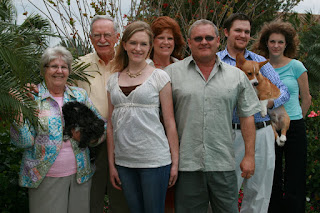
It's that time of the year when high school seniors start to hear whether they have been accepted by this or that university. My granddaughter Cassie just returned from a trip to Boston with her parents. She has been accepted by M.I.T. and is excited about what the next years of her education hold for her. She sent me an email, saying she'd be posting her Boston photos on Facebook soon. In addition, she sent a family photo taken in their back yard during the recent Easter holiday. 

Of course, I made the photo my computer's desktop display. Now every time I open up, I see my daughter Cheryl, her husband Derrick, Cassie, her brother Shawn and his fiance Marian, all standing with Sylvia and me, smiling. I studied their faces, particularly the noses. Cassie has a nose just like her mother's and Shawn has one like Sylvia's. I couldn't locate anyone with one quite like my own hang-down type. 

All that got me thinking about family and the way the Lord God has ordered life on this earth. That also jibed well with my meditation one morning last week on Jesus' comments about honoring one's parents in Matthew 15 and again in Matthew 19. He referenced the commandment given through Moses in the days of the Exodus, "Honor your father and your mother, so that you may live long in the land the LORD your God is giving you." The command was repeated shortly before the Children of Israel entered the promised land: "Honor your father and your mother, as the LORD your God has commanded you, so that you may live long and that it may go well with you in the land the LORD your God is giving you."

As has often been noted, this is the first commandment with a promise: "that you may live long in the land the LORD your God is giving you." Like many, I've often wondered what the promise means? Does it mean that we'll each receive the blessing of a long life if we honor and respect our parents? If so, it does not seem to work out. I know many who so honored their parents and yet died long before old age. What then? 

I believe there are several clues to the meaning hidden in the text. The first is in the pronoun you. It is a plural pronoun. Consequently it refers to the entire people, not to each individual. It refers to the lifestyle and customs of the people. If they treasure and hold parenthood and family in high regard, the LORD will smile upon them. 

The land was the land given to them by God's promise. Specifically it referred to that area we since have learned to call the Holy Land, stretching from Egypt to Damascus. The Hebrew has two words for land, eretz and adamah. In the case of this commandment, the word adamah is used. Adamah refers to land that is arable, farming land. Since Israel's was primarily an agricultural culture, the promise had to do with God's blessings upon their vineyards, olive orchards, grain fields and the like. 

Finally, the blessing has to do with living in this land described in the Bible as good and spacious, flowing with milk and honey. If they respected this command along with the other commands and teachings given to them, they would continue to live and prosper in this land. The LORD of the covenant, the One who had rescued and redeemed them from bondage and slavery, would bless them over the years. 

It is a good and important lesson, one we do well to learn wherever we may be. This has especially to do with those of us who have accepted the Good News of Jesus Christ, risen from the dead. He is that LORD of whom the commandment speaks. He has set us aside to honor Him in the land where He has called us to be. In the United States that no longer refers to a land whose economy is based upon agriculture. Nor is ours a rural life. We are predominantly an urban culture. Yet in this land we continue to marry and have children. 

The LORD's blessings rests upon this fundamental institution. I will not lay out the complete details of this teaching. Suffice it to say there are several vital implications for us in our day. 

Marriage is the union of one man and one woman. There is no other definition in God's Word. It can never be redefined as the union of two men or two women or any other combination. 

Children are to be brought up in such a family. It is not always possible. The LORD calls upon some single moms or dads to raise their children without a spouse. Yet children need the guidance and direction of both men and women. Here the extended family and the local congregation of families have a duty toward the children. We need to give careful thought to this in these days of artificial insemination. 

And the children, in turn, have a duty toward their parents to honor, respect, revere and hold in high regard those whom the LORD has placed over them. This refers first to one's biological parents, but it does not stop there. It refers as well to grandparents, aunts, uncles and all older members of the family. But then it goes beyond to spiritual parents, teachers and pastors. And finally it refers to our parents in the civil realm, those in authority over us, police, judges, legislators and soldiers. 

This is the ordering of human life set down by our Creator and LORD. Acknowledge it, follow it and we will all receive His blessings. Ignore it, make up our own rules, and He will withdraw His hand of blessing from us. 

Oh, by the way, I checked some other family photos. I believe my second son Nathan is the only one who has a nose anywhere close to mine. Strange.