Showing posts with label Herod's Temple. Show all posts

Monday, November 4, 2013

Christ—Once For All

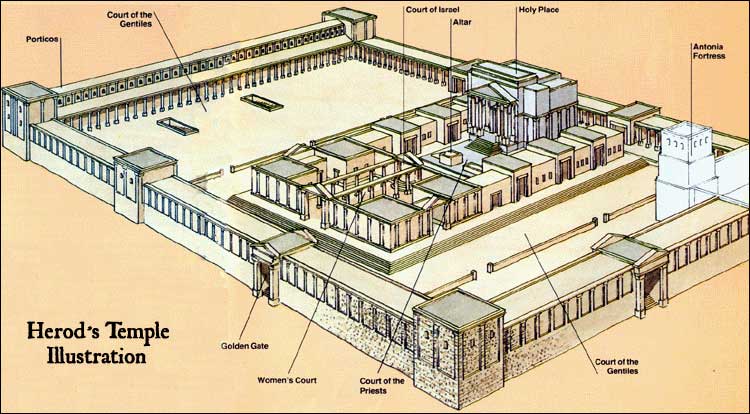
Many Jews—and Christians—long for the rebuilding and restoration of the Temple in Jerusalem. Some even believe that the Ark of the Covenant is hidden somewhere deep underneath the mount of the original temple. Within the original temple (and the earlier Tabernacle / Tent) were two holy areas, accessible only by the priests. The first section held the lamp stand and the table for the bread of the Presence (Exodus 25:23-30). It was called the Holy Place.

The Holy Place was divided from a second section by a massive curtain. Behind that curtain was the Most Holy Place. In it was the golden altar of incense and the Ark of the Covenant. In the Ark were the golden urn containing some of the original manna from the wilderness journey, Aaron's staff that budded, and the tablets of the covenant—all very ancient and very sacred (Exd 25:10-21; Exd 26:33; Exd 37:1-5; Exd 39:35; Exd 40:3,20,21). But all part of the past. We do not expect the temple ever to be rebuilt. 

The writer to the Hebrews says that all that went on in the Temple, the sacrifices and rituals in the courtyard and in the two holy places dealt only with food, drink and various bodily washings, plus the blood of goats, calves and bulls and the sprinkling of defiled persons with the ashes of a heifer. All that did nothing to cleanse hearts and souls. What does? That is the prime question of chapter 9. What truly brings the forgiveness of sins? What is better? The answer: Jesus Christ!
For Christ has entered, not into holy places made with hands, which are copies of the true things, but into heaven itself, now to appear in the presence of God on our behalf. Nor was it to offer himself repeatedly, as the high priest enters the holy places every year with blood not his own, for then he would have had to suffer repeatedly since the foundation of the world. But as it is, he has appeared once for all at the end of the ages to put away sin by the sacrifice of himself. - Hebrews 9:24-26 ESV
What is this end of the ages? The word end actually refers to completion or consummation. This is what the former ages pointed to, what they were leading up to. The time of the Temple and all the sacrifices, washings and drinks is over. They were the shadows. Christ is the Body. They were symbolic. Christ is the fulfillment. His coming is the once for all event that has brought all the rest to its completion.
And just as it is appointed for man to die once, and after that comes judgment, so Christ, having been offered once to bear the sins of many, will appear a second time, not to deal with sin but to save those who are eagerly waiting for him. - Hbr 9:27-28 ESV
Once for all. It is over and complete. All that the earlier system pointed toward has now been fulfilled. Christ came. He finished the work. By raising Jesus from the dead the Father has announced His acceptance of the sacrifice of His Son with whom He is well pleased. Jesus will now appear a second time to save all of us who eagerly await Him. To Him be all glory and praise!  

Tuesday, January 8, 2013

Jesus' Wake Up Call

For Many Orthodox Christians, Christmas Is Just Beginning : NPR: Some of you may be already packing up your decorations, but many Orthodox Christians are just getting ready for their Christmas
celebration. That's because many Orthodox churches follow a different calendar, the Julian calendar, and for them, Christmas falls on January 7th.

The Julian calendar was introduced by Julius Caesar in 45 BCE (Before Common Era) and replaced the Roman calendar. The Gregorian calendar is today's internationally accepted civil calendar and is also known as the "Western calendar" or "Christian calendar". It was named after the man who first introduced it in February 1582: Pope Gregory XIII.

We use calendars for a wide variety of reasons. One, of course, is to mark the seasons. Based upon the time of the year we assume it will be cold and snowy or hot and humid. So we make plans accordingly.  Jesus' disciples were concerned about more than the weather when the Lord told them that Herod's majestic temple was soon to be torn to the ground.
Jesus left the temple and was going away, when his disciples came to point out to him the buildings of the temple. But he answered them, "You see all these, do you not? Truly, I say to you, there will not be left here one stone upon another that will not be thrown down." As he sat on the Mount of Olives, the disciples came to him privately, saying, "Tell us, when will these things be, and what will be the sign of your coming and of the end of the age?"  - Mat 24:1-3 ESV


With these words Matthew opens the fifth and final chapter of his account of Jesus' life and teachings. Jesus and his disciples are on the Mount of Olives, the hill that overlooks the city of Jerusalem. Below them are the majestic buildings that make up the temple that Herod built for the Jews. The historian Josephus said that much of the exterior of the Temple was covered with gold that reflected the fiery rays of the sun. Moreover, he said that from a distance the Temple appeared like a mountain covered with snow. This was probably because those parts not covered with gold were made of white stone.

Gazing down from the Mount of Olives upon that Temple, Jesus' disciples accepted Jesus' prediction about the Temple's destruction, but his prophecy raised two vital questions:

  • "Tell us, when will these things be?" 
  • "What will be the sign of your coming and of the end of the age?" 
Jesus knew that the temple would be torn down by the Romans in 70 A.D, but he did not supply that information to his disciples. He did not give them a specific date. Nor did he answer their second question directly. He wanted them—and us—to remember that the LORD God is ever and completely in control of the events of history in every age. What Jesus supplies in these next verses is a solemn reminder of that. What concerns him are the false prophets who will arise as his disciples await his second coming. He must warn us about what to expect in this age or eon and about the false prophets' interpretations of those events leading up to his return. In my next post we will examine in more detail Jesus' response to the second question and why he refuses to supply a specific and concrete answer to the first. His overarching concern is stated in these words:
Therefore, stay awake, for you do not know on what day your Lord is coming. - Mat 24:42 ESV