Showing posts with label end of the age. Show all posts

Monday, December 21, 2015

Armageddon

An asteroid the size of Texas is about to impact the earth. One month remains before the entire planet will be obliterated. NASA recruits a team of deep core drillers and amazingly they do it. They save the world from total destruction. The movie's title? Amageddon!

Movie Review #JPMN
In a similar 1996 movie (Independence Day) aliens are coming with vastly superior technology. They intend to invade and destroy the earth. But a brave group of pilots manage somehow to destroy their huge spaceship. Now, in a 2016 movie, another group will have to save our planet as the same group of aliens returns in Independence Day II, only with even greater technology.

What's going on? Why are we fascinated by the possibility of some grave terror coming to destroy us all? And why suggest that the strange word Armageddon points to it? Perhaps it is because we partly do and partly do not believe it possible.

The word Armageddon appears but once in the Bible, in Rev. 16:16.
And I saw, coming out of the mouth of the dragon and out of the mouth of the beast and out of the mouth of the false prophet, three unclean spirits like frogs. For they are demonic spirits, performing signs, who go abroad to the kings of the whole world, to assemble them for battle on the great day of God the Almighty. ("Behold, I am coming like a thief! Blessed is the one who stays awake, keeping his garments on, that he may not go about naked and be seen exposed!") And they assembled them at the place that in Hebrew is called Armageddon. - Rev 16:13-16 ESV
The word is a transliteration of a Hebrew word into the Greek language: Harmageddon.  Spelled that way the Hebrew could literally mean hill (har) or mountain of Megiddo, a place of crowds (remember that the Hebrew in John's time had no vowels). This Megiddo was actually not a mountain. It was barely a hill in the plain of Esdraelon on which many generations had lived and built forts to guard the Via Maris, the trade route that linked Egypt with the empires of Syria, Anatolia and Mesopotamia to the north. Many, many battles were fought in that great plain southwest of the southern tip of the Sea of Galilee (Judges 5:19-21; 2 Kings 9:27; 23:29). However,  no one knows for certain what Armageddon means. While some spell the word in the Greek as Harmageddon, scribes of other manuscripts spell the word with one d and two g's; others with two d's and one g as above.

The Seven Bowls or Vials judgments described in Rev. 16 differ from the earlier Seven Trumpet judgments of Rev. 8:1-6. They bring final judgment upon all those who have taken the mark of the Beast and upon the earth itself. For an extended and detailed description of the varied views about Armageddon check out the Christian Eschatology articles in Wikipedia, especially the articles under the sub-titles: contrasting beliefs, the millennium, Biblical texts and key terms.  More details are also included in the seven bowls article.

The position of this blog is that the seven bowls and Armageddon are images, symbols. They are not to be taken literally. A literal battle will not take place on the literal plain of Megiddo in northern Israel. Nor dare we expect a literal thousand years, a millennium, to follow. What then awaits? To what do these symbols point? Using familiar language pointing to a place of many battles over the centuries, John symbolizes the final great conflict between the forces of good and the forces of evil, a battle in which the forces of evil will be defeated by God's Incarnate Word, Jesus Christ (Rev. 19:11-16). The judgments of God are coming upon the earth and upon all who have opposed Him. And
"blessed is the one who stays awake, keeping his garments on, that he may not go about naked and be seen exposed" — Rev. 16:15 ESV


Tuesday, January 28, 2014

Apostacy—The Sign Of Christ's Return

In every age Christians have declared that the end of the age is upon us. Christ is certainly about to return. The signs are all there as proclaimed in the Gospels. Examples abound. Consider the LORD's words as recorded by St. Matthew:
As he sat on the Mount of Olives, the disciples came to him privately, saying, "Tell us, when will these things be, and what will be the sign of your coming and of the end of the age?" 
And Jesus answered them, "See that no one leads you astray. For many will come in my name, saying, 'I am the Christ,' and they will lead many astray. And you will hear of wars and rumors of wars. See that you are not alarmed, for this must take place, but the end is not yet. For nation will rise against nation, and kingdom against kingdom, and there will be famines and earthquakes in various places. All these are but the beginning of the birth pains. 
"Then they will deliver you up to tribulation and put you to death, and you will be hated by all nations for my name's sake. And then many will fall away and betray one another and hate one another. And many false prophets will arise and lead many astray. And because lawlessness will be increased, the love of many will grow cold. But the one who endures to the end will be saved. - Mat 24:3-13 ESV 
OK,  the beginning of the birth of the new age has begun. But what is the sign of our LORD's coming? What is the sign of the end of the age? If not wars, famines, earthquakes and persecutions of believers, what then? Are false prophets and lawlessness? They are indeed. Apostasy is the sign!

Who can deny that false teaching and the apostasy or falling away from the faith Jesus predicted, started already in N.T. times? Consider how Peter and the other disciples deserted the LORD during His passion. And remember that an earthquake and signs in the heavens occurred during His suffering upon the cross (Matt. 24:29; 27:45). Further, read the Epistles and you see that the Apostles and their churches had to contend with enemies both outside and from within the bosom of the church.

Gnosticism was already rampant in the second century. That strange teaching with its many forms tore the church apart for hundreds of years. It remains very active in the modern world as these prophets separate creation from redemption and rely upon personal religious experience rather than God's Word!

The LORD Jesus prophesied apostasy, denial of the Trinity, salvation by good works and all the false teachings against which the Lutheran Reformation raged. Consider also how Jesus' predictions were horribly fulfilled in the rise of the false prophet Muhammed and what a challenge to the Christian faith this religion has become now in the 21st century.

In this connection I commend to you a 2012 book by Bill Hecht, Two Wars We Must Not Lose: What Christians Need to Know About Radical Islamists, Radical Secularists, and Why We Can't Leave the Battle Up to Our Divided Government. Hecht says that radical Islamist terrorists are committed to the destruction of America and they will not let up! The second "cultural war" began in earnest in the 1940s with the separation of church and state by means of the U.S. Supreme court's decision, Everson v. Board of Education. Hecht argues that such an absolute separation was never intended by the founders of the United States. These wars, says Hecht, we must not lose. If we do we will lose our country and the freedoms it has offered from its beginning.

The rejection of Scriptural authority is a prime accomplishment of secularists working from within the church. Among the so-called mainline protestant churches there is an almost universal adoption of the higher-critical method of Scriptural scholarship. In so doing these churches have capitulated to the Enlightenment of the 18th and 19th centuries. The old confessions of these churches are now useless. Things have so degenerated that when the World Council of Churches was founded it in 1948 it was unable to affirm even the mystery of the Blessed Trinity (see Henry Bettenson, Documents of the Christian Church, 2nd ed.). One must grant that recent revisions seem to suggest some kind of agreement upon the divinity of Christ and the reality of the Trinity, but don't press too far beyond the opening words themselves to documents published by the organization.

In these next weeks I will continue to review some of the things mentioned above and explore with you how apostasy is THE SIGN of our time, the Sign pointing to the imminent return of Christ.

Monday, November 4, 2013

Christ—Once For All

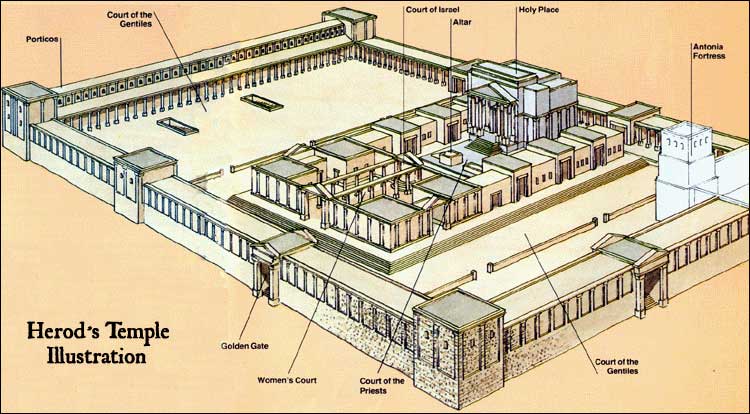
Many Jews—and Christians—long for the rebuilding and restoration of the Temple in Jerusalem. Some even believe that the Ark of the Covenant is hidden somewhere deep underneath the mount of the original temple. Within the original temple (and the earlier Tabernacle / Tent) were two holy areas, accessible only by the priests. The first section held the lamp stand and the table for the bread of the Presence (Exodus 25:23-30). It was called the Holy Place.

The Holy Place was divided from a second section by a massive curtain. Behind that curtain was the Most Holy Place. In it was the golden altar of incense and the Ark of the Covenant. In the Ark were the golden urn containing some of the original manna from the wilderness journey, Aaron's staff that budded, and the tablets of the covenant—all very ancient and very sacred (Exd 25:10-21; Exd 26:33; Exd 37:1-5; Exd 39:35; Exd 40:3,20,21). But all part of the past. We do not expect the temple ever to be rebuilt. 

The writer to the Hebrews says that all that went on in the Temple, the sacrifices and rituals in the courtyard and in the two holy places dealt only with food, drink and various bodily washings, plus the blood of goats, calves and bulls and the sprinkling of defiled persons with the ashes of a heifer. All that did nothing to cleanse hearts and souls. What does? That is the prime question of chapter 9. What truly brings the forgiveness of sins? What is better? The answer: Jesus Christ!
For Christ has entered, not into holy places made with hands, which are copies of the true things, but into heaven itself, now to appear in the presence of God on our behalf. Nor was it to offer himself repeatedly, as the high priest enters the holy places every year with blood not his own, for then he would have had to suffer repeatedly since the foundation of the world. But as it is, he has appeared once for all at the end of the ages to put away sin by the sacrifice of himself. - Hebrews 9:24-26 ESV
What is this end of the ages? The word end actually refers to completion or consummation. This is what the former ages pointed to, what they were leading up to. The time of the Temple and all the sacrifices, washings and drinks is over. They were the shadows. Christ is the Body. They were symbolic. Christ is the fulfillment. His coming is the once for all event that has brought all the rest to its completion.
And just as it is appointed for man to die once, and after that comes judgment, so Christ, having been offered once to bear the sins of many, will appear a second time, not to deal with sin but to save those who are eagerly waiting for him. - Hbr 9:27-28 ESV
Once for all. It is over and complete. All that the earlier system pointed toward has now been fulfilled. Christ came. He finished the work. By raising Jesus from the dead the Father has announced His acceptance of the sacrifice of His Son with whom He is well pleased. Jesus will now appear a second time to save all of us who eagerly await Him. To Him be all glory and praise!  

Friday, January 11, 2013

More About The End Of The Age


My astute friend Harold wrote some insightful comments about my previous posting. I review them here and add some more of my own with helpful links. Harold's are in italics.
When Jesus in v. 6 of Mt. 24 says, "But the END is not yet", I believe that the word in Gk. "telos", refers not to the "end of the world", for Jesus does not there use the word, sunteleia, of 24:3.I believe He is speaking of the things that will happen before the "END" of the TEMPLE (Jesus' prediction of temple's destruction was a blow too hard to believe for disciples). The disciples were shocked to hear Jesus predict the destruction of the temple.
Matthew reports Jesus' using the Gk. word sunteleia to speak exclusively about the "end of the age":

  • . . . and the enemy who sowed them is the devil. The harvest is the end of the age, and the reapers are angels. Just as the weeds are gathered and burned with fire, so will it be at the end of the age. ... So it will be at the end of the age. The angels will come out and separate the evil from the righteous - Mat 13:39-40, 49 ESV 
  • teaching them to observe all that I have commanded you. And behold, I am with you always, to the end of the age." - Mat 28:20 ESV
Harold continues:
Their question was "WHEN shall 'these things' be?" When Jesus says 'YOU" in v. 6, v. 9, v. 14,v.23,25, He is speaking to THAT generation which would be around when the armies of Rome would encircle Jerusalem.The "abomination of desolation"would be SEEN, and acc. to Lk.21:20 that abomination was the entry of pagan armies into Jerusalem and the temple . Eusebius reports that believers, remembering Jesus' words, fled to the hills when Rom. armies began to come to jerusalem. 

Eusebius was a 4th century bishop of Caesarea. He wrote a chronological account of early Christianity from the first century to his own. He does indeed write about the destruction of Jerusalem by the Romans and the predictions of Christ. They are quoted by eschatology.org.


Harold speaks about modern attempts to interpret Matthew:
I note that premillenialists use the words of Mt. 24 in such a way as though Jesus were speaking to US in the 20th or 21st centuries, as the "Left Behind" series of novels show, and eisegizing a present Jewish people into the text who are to also "flee to the hills", etc.
Patrick Zukeran of PROBE ministries refers to Hank Hanegraaff's book The Apocalypse Code as he writes about the conflicting views about the end of the age. He notes that the debate has continued throughout the history of the church, based not only on Matt. 24, but especially on the Book of Revelation. Harold's word "eisegizing" refers to the practice of reading words and ideas into the Biblical text rather than letting the text speak for itself.


Harold continues with some historical comments about the Roman world of that day.
Jesus says that before the "END" of the temple, 70 A.D., the Gospel would go to all nations, and it did (Rom.1:8;, Rom.16:26, Col.1:6, Col 1:23). There was political turmoil at the time of 70 A.D.(4 emperors in 18 months)there were numerous wars(v.6), famines and earthquakes (v.7).All these things took place in the decades before 70 A.D.  
There were indeed many Roman Emperors in the first century. They had quite a passion for killing off one another. You can read more about the destruction of Jerusalem and the horrors, famines and pestilence connected with in in Josephus' history.


Harold concludes his comments with these words:
I see these words of Jesus in Matt. 24, as the author of the study on Revelation (forgot his name, publ. by CPH) says, "are a microcosm" of the End of all things, and Judgment Day. . . . . h.h. 

He probably refers to Louis A Brighton's several commentaries published by Concordia Publishing House on the Book of Revelation in the Concordia Commentary series.

Thank you Harold. You have expanded our understanding of Matt. 24 and strengthened our faith in the promised return of the Lord Jesus. Even so, come Lord Jesus. Amen.

Tuesday, January 8, 2013

Jesus' Wake Up Call

For Many Orthodox Christians, Christmas Is Just Beginning : NPR: Some of you may be already packing up your decorations, but many Orthodox Christians are just getting ready for their Christmas
celebration. That's because many Orthodox churches follow a different calendar, the Julian calendar, and for them, Christmas falls on January 7th.

The Julian calendar was introduced by Julius Caesar in 45 BCE (Before Common Era) and replaced the Roman calendar. The Gregorian calendar is today's internationally accepted civil calendar and is also known as the "Western calendar" or "Christian calendar". It was named after the man who first introduced it in February 1582: Pope Gregory XIII.

We use calendars for a wide variety of reasons. One, of course, is to mark the seasons. Based upon the time of the year we assume it will be cold and snowy or hot and humid. So we make plans accordingly.  Jesus' disciples were concerned about more than the weather when the Lord told them that Herod's majestic temple was soon to be torn to the ground.
Jesus left the temple and was going away, when his disciples came to point out to him the buildings of the temple. But he answered them, "You see all these, do you not? Truly, I say to you, there will not be left here one stone upon another that will not be thrown down." As he sat on the Mount of Olives, the disciples came to him privately, saying, "Tell us, when will these things be, and what will be the sign of your coming and of the end of the age?"  - Mat 24:1-3 ESV


With these words Matthew opens the fifth and final chapter of his account of Jesus' life and teachings. Jesus and his disciples are on the Mount of Olives, the hill that overlooks the city of Jerusalem. Below them are the majestic buildings that make up the temple that Herod built for the Jews. The historian Josephus said that much of the exterior of the Temple was covered with gold that reflected the fiery rays of the sun. Moreover, he said that from a distance the Temple appeared like a mountain covered with snow. This was probably because those parts not covered with gold were made of white stone.

Gazing down from the Mount of Olives upon that Temple, Jesus' disciples accepted Jesus' prediction about the Temple's destruction, but his prophecy raised two vital questions:

  • "Tell us, when will these things be?" 
  • "What will be the sign of your coming and of the end of the age?" 
Jesus knew that the temple would be torn down by the Romans in 70 A.D, but he did not supply that information to his disciples. He did not give them a specific date. Nor did he answer their second question directly. He wanted them—and us—to remember that the LORD God is ever and completely in control of the events of history in every age. What Jesus supplies in these next verses is a solemn reminder of that. What concerns him are the false prophets who will arise as his disciples await his second coming. He must warn us about what to expect in this age or eon and about the false prophets' interpretations of those events leading up to his return. In my next post we will examine in more detail Jesus' response to the second question and why he refuses to supply a specific and concrete answer to the first. His overarching concern is stated in these words:
Therefore, stay awake, for you do not know on what day your Lord is coming. - Mat 24:42 ESV


Monday, November 26, 2012

He Is With Us Always, To The End

This week we Christians begin our annual four weeks of preparing to celebrate the first coming or birth of our Lord Jesus. During these four weeks we meditate upon the several other ways by which Jesus comes or will come among us. We rejoice that he has never in fact left us, but rather remains very present to speak to us and guide us in his living Word as well as in in the sacraments of Baptism and his holy Supper. In this way he fulfills his promise to be with us to the very end of this age. And yes, this present age will come to its appointed end. Then he will return in glory with all his holy angels (Matt. 16:27; 24:30; Mark 10:37).

As has often been true, unbelievers view this prophecy as so much nonsense or they get all wrapped up in other esoteric prophecies like the Mayan calendar's prediction of the end on December 21, 2012, less than a month from the day upon which I write these words. In response to Jesus' disciples' private question about what was to be the sign of his return and the end of the age he said,
"But concerning that day and hour no one knows, not even the angels of heaven, nor the Son, but the Father only." - Mat 24:36 ESV
Mocking those who promote about the Dec. 21 date, our pastor recently quipped in his sermon, "Can you imagine the let down for those folks when it doesn't happen? And wouldn't it be neat if just when they give up in despair, Jesus comes back on Dec. 22!"

So what about all this business of the end of days and signs of Jesus' return? Jesus told us before his own crucifixion that there would be (Matt. 24:3-31; Luke 21:5-38):

  • messianic leaders promising to save the world from all its woes 
  • wars and rumors of wars
  • nations or kingdoms rising up against other nations or kingdoms
  • terrors from the heavens
  • famines in various places
  • earthquakes
  • tsunamis and floods
  • hurricanes and tornadoes
  • plagues and epidemics
  • widespread drunkenness from drugs 
  • persecution and murder of Christians

Sounds like today's news reports from around the world, doesn't it?

We believers sometimes panic when we hear about these things. Do not. While the list above gives us good reason to be sober about what is happening around us, we have no reason to panic. We always remember Jesus' promise just before his ascension,

"Behold, I am with you always, to the end of the age." - Mat 28:20 ESV
So we go about the work he has given to us as we await his return. Moms care for their kids. Dads teach their sons to throw a baseball. Engineers design bridges, lawyers plead cases before judges, musicians create music. We join hands to feed the poor, care for the sick and weak, rescue folks from various disasters and whenever we have opportunity we share the good news about Jesus. And all the time we remain awake and in prayer, awaiting his return at any time (Matt. 24:44-47).