Showing posts with label brevity of life. Show all posts

Tuesday, January 31, 2012

Honoring And Caring For The Elderly

Since I am one of the senior citizens of this land, it seems wise to prepare for the inevitable. My body continues to age—there seems but little I can do to alter that fact. I have annual checkups with my docs and follow a planned regimen of a healthy diet and exercise. My wife and I are fairly active in our social life. We interact with friends and family every day. We went with friends out to eat and to a concert this past weekend. We spent an hour on the phone last night planning a cruise in the Caribbean with our family next summer. The planned cruise will follow the graduation of our granddaughter from college.

Yet the time approaches when my wife and I may not be able to manage our own affairs. We'll need the assistance of our children and/or professional caregivers. That's why, as the new year turned, we did an extensive review of our financial situation. Do we have sufficient funds to cover the possible need for home health care? What if we have to move to an assisted living community? We came away from that review satisfied that we are in a relatively good position. I say relatively, because we also realize that we simply cannot foresee every possible scenario. Nor are we going to spend the remainder of our lives imagining the worst. 

In poking around on the internet I found a helpful site, one that speaks both to those of us who are seniors and those of you who will or already do face the challenge of caring for your parents or relatives. I commend it to you. It's called Aging Care—connecting people caring for elderly parents. Lots of good stuff there and many helpful links. Check it out.

This task of caring for aging parents and relatives is not easy. And the fact is there's a whole lot more of us now than ever before. Here's an interesting 2009 comment on life expectancy by Tara Parker-Pope in The New York Times: 
Americans are living nearly two-and-a-half months longer, according to new life expectancy statistics released today. In 2007, life expectancy in the United States reached a high of nearly 78 years, up from 77.7 a year earlier. 
Life expectancy in the United States has been on the rise for a decade, increasing 1.4 years — from 76.5 years in 1997 to 77.9 in 2007, according to the Centers for Disease Control and Prevention. The life expectancy data, compiled by the agency’s National Center for Health Statistics, are based on nearly 90 percent of the death certificates filed in the United States. 
Doctors say that not only is lifespan increasing, but more important, the “active” lifespan is increasing as well. 
“The most noteworthy aspect about all this is not just that people are living longer but living better,” said Dr. Gary Kennedy, director of geriatric psychiatry at Montefiore Medical Center in the Bronx, N.Y. “At the same time, people are living a longer active lifespan. Seniors are healthier, more active and economically better off than they ever have been.”
So many of us are going to be around a lot longer than a few decades ago. This presents challenges—and benefits—to communities and governments as well as families. What are some of the things the Bible says about all of this? Here are a few quotes:
For all our days pass away under your wrath; we bring our years to an end like a sigh. The years of our life are seventy, or even by reason of strength eighty; yet their span is but toil and trouble; they are soon gone, and we fly away. Who considers the power of your anger, and your wrath according to the fear of you? So teach us to number our days that we may get a heart of wisdom. - Psa 90:10-12 ESV
The righteous flourish like the palm tree and grow like a cedar in Lebanon. They are planted in the house of the LORD; they flourish in the courts of our God. They still bear fruit in old age; they are ever full of sap and green, to declare that the LORD is upright; he is my rock, and there is no unrighteousness in him. - Psa 92:12-15 ESV
The glory of young men is their strength, but the splendor of old men is their gray hair. - Proverbs 20:29 ESV 
Listen to your father who gave you life, and do not despise your mother when she is old. - Proverbs 23:22 ESV
Good counsel from the LORD Himself. A heart of wisdom has to do with learning both about our sinfulness and also our Savior, Jesus, God's wisdom (1 Cor.1:24). Guided by Him we become both aware of life's brevity, regardless of our age, and life's hope, reaching into eternity.

And note the promise about the righteous, that is  those who walk by faith. "They are ever full of sap and green." Yes, we have His life flowing within and a whole life of experience to share how He blesses, rebukes, forgives and guides. Not all wisdom resides in the youth. We grey hairs have much to share. And so we shall, with love and patience as the opportunity arises.

And finally, a word of encouragement to all caregivers of us elderly. Think about what your parents gave to you. Life is much more than physically breathing, drinking, eating and walking around. Your parents gave you family life and an extended family, guidance and support as you matured and above all, they led you to Him from whom all life flows, even Jesus. If any or all of this is true, you have the responsibility in love to actively listen to them and honor them as they age. Many blessings flow from following the command to honor your father and mother. He promises that your life and the lives of your children will be blessed by the LORD who gave us this command from the beginning:
"'Honor your father and your mother, as the LORD your God commanded you, that your days may be long, and that it may go well with you in the land that the LORD your God is giving you. - Deut. 5:16 ESV


Monday, September 12, 2011

Is Human Immortality Once Again On The Horizon?

Did men once live to be hundreds of years old? According to the Bible there were many. Why then do men live only 70 or 80 or so years today? Will modern science change that? Will we once again live to be hundreds of years old?

Christian authors Fazale Rana, Hugh Ross and Richard Deem tell us  that
"the mere assertion that humans could live more than 900 years—as Genesis 5:5 states—seems, for many people, nothing short of absurdity. The mention of long life spans in Genesis 5 hinders these people from openly exploring the Christian faith. Unable to accept 900-year human life spans, skeptics and others view the Bible as unreliable, a book of human myth rather than divine revelation."
Here's what the Genesis 5 passage says:

  • Adam lived 930 years
  • Seth, Adam's son lived 912 years
  • Enosh, born when Seth was 105, lived 902 years
  • Enosh's son, Kenan, 910 years
  • Mahalalel 895 years
  • Jared 962 years
  • Enoch 365 years and then "God took him away"
  • Methuselah, Enoch's son, lived 969 years
  • His son Lamech lived 777 years
  • Lamech's son Noah was 500 years old when he fathered Shem, Ham and Japheth
This means that Noah's father, Lamech, spent many decades with Adam before he died. And all these men "had other sons and daughters." How many people were there on the earth when God sent the flood? One author estimates 6 million and finds that a ridiculous number for God to destroy. He views the flood as a parable anyway. Other estimates range all the way from 300,000 to 17 billion. No one knows. I'm not pursuing that question today. I'm rather asking whether the long ages suggested by Genesis could once again come to pass. 

Journalist and bestselling sci-fi author Ben Bova wrote a 2009 novel, The Immortality Factor , as a follow-up to his earlier report on medical advances, Immortality: How Science Is Extending Your Life Span. In that book he predicted that advances in understanding why people age and die will soon lead to the ability to reverse aging. Immortality will soon be possible and the 900 yr. + lifespans of pre-flood men will become possible. He writes about the same scientific advances outlined by the Christian authors I quoted above, namely
  • Reversing the effects of free radicals or reactive oxygen species
  • Caloric restriction, i.e. a vegetarian diet to prevent the intake of toxins from animal flesh
  • Altering the loss of telomere length
  • Genome size - the Human Genome Project indicates humans have 3 billion base pairs, but only 28-120,000 genes. Non-coding DNA makes up about 97% of the human genome. There seems to be a relationship between a large genome and long life
  • Cosmic radiation that plays a significant role in limiting life expectancy
  • Advances in endocrinology and hormonal control.
In later blogs I'd like to link this information to what the Bible means when it speaks of death. Note for instance that when Adam and Eve disobeyed, they immediately died. The LORD told Adam,
“You are free to eat from any tree in the garden; 17 but you must not eat from the tree of the knowledge of good and evil, for when you eat from it you will certainly die” (Genesis 2:16-17).
 When Adam and Eve ate the forbidden fruit they died. They were no longer in a loving, faithful and open relationship with the LORD. The full, abundant life they had known before their disobedience was gone. Thousands of years later the LORD came among us as the second Adam so that He might restore life as full, complete and eternal fellowship with our Creator (1 Cor. 15:22,45). As Jesus said, "The thief comes only to steal and kill and destroy. I came that they may have life and have it abundantly" (John 10:10). I'll pursue the implications of that in later blogs. The point is this: the LORD may allow us to discover ways to extend human longevity. Lifespans already have lengthened in the past hundred years, but that in itself cannot even begin to bring us the life that the LORD Jesus speaks about. 


Thursday, April 21, 2011

Your Labor Is Not In Vain

John's Gospel is packed with Jesus' teachings during the hours He gathered with His disciples to celebrate the Passover, Thursday evening of Holy Week. All through these teachings He constantly reminded His disciples that He was to die and that they would all desert Him. One of them would even betray Him. In that dark hour He was to fight His final battle with the ruler of this world. Yet even in His death He would not betray them whom He called His friends. So they must abide in Him as branches abide in the vine. His words must be held continually in their hearts. Then they would bear fruit as branches of the grapevine do (John 15:1-8).

Much of this they did not understand. Later, when the Spirit of truth came, He would guide them into the truth. Then they would see and understand: "A little while, and you will see me no longer; and again a little while, and you will see me" (John 16:16).

After Jesus' wonderful prayer to His Father (John 17:1-26), He went with them across the Kidron Valley to the Garden of Gethsemane to pray (John 18:1-2).


In all of this He says nothing about the Lord's Supper, mentioned so prominently in the other three Gospels. Or does He? Not in these chapters, but many feel that John records Jesus' teachings about the Supper in John 6 as He calls Himself the Bread of Life (John 6:48-51). In those verses He calls us all to look back to the story of ancient Israel's 40 years of wandering in the wilderness of Sinai.  All through those years they survived by eating the strange food called manna. The word is a question in Hebrew meaning, "What is it?" They never knew. All they knew was that it was there every morning and that it kept them alive until they entered the land of Canaan (Exodus 16:31-35; Numbers 11:6-9; Joshua 5:12).

The manna was very humbling. It taught them that they were totally dependent upon God's mercy, forgiveness and blessing. His creative Word produced it for them. It was not of their doing. They could not reproduce it nor save it. When they did it became rotten, stank and bred worms (Exodus 16:20). No it was their daily bread, nothing more, nothing less.

So Jesus describes Himself as our Bread of Life. His flesh is food indeed and His blood drink indeed (John 6:55). His flesh is for the life of the world. He who eats of it will not die as did the Israelites in the wilderness. Instead he will live forever! (John 6:51). Hard to believe, but that is the promise.

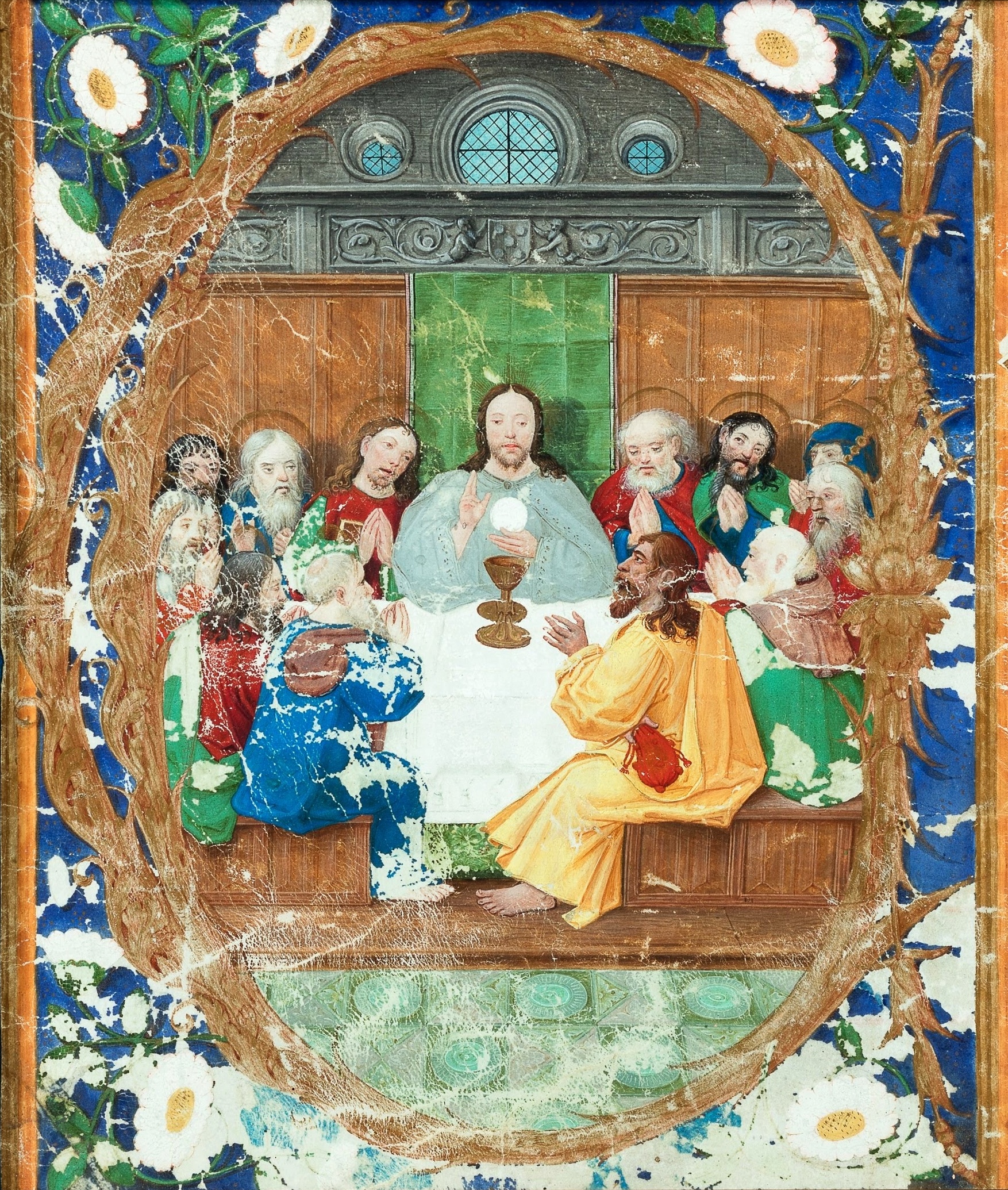
On this Thursday Christians around the world recall Jesus' institution of His Supper. We do not try to provide logical explanations for the meal. We do not analyze it. That's not its purpose. It is and will ever be a mystery. We eat of this bread and indeed it is bread. We drink of the wine, fruit of the vine. But over these earthly things He speaks His Words, "This is my Body . . . This is my Blood." And we each individually are nourished again for our personal journeys. We are assured that our sins are forgiven, forgotten and removed. So we go forth from the Supper renewed, strengthened for the next leg of our journey. And all the while we are confident that though our bodies will perish another mystery awaits us. This perishable, mortal body will be changed and we will put on immortality. Death will be swallowed up in the victory that is ours in our risen Lord (1 Corinthians 15:51-58):
"Therefore, my beloved brothers, be steadfast, immovable, always abounding in the work of the Lord, knowing that in the Lord your labor is not in vain."

Monday, February 21, 2011

Incomplete Healing

For the past couple weeks I've been meditating on the ministry of reconciliation and focusing especially on the guidance the Apostle James gives,
"Is anyone among you suffering? Let him pray. Is anyone cheerful? Let him sing praise. 14Is anyone among you sick? Let him call for the elders of the church, and let them pray over him, anointing him with oil in the name of the Lord. 15And the prayer of faith will save the one who is sick, and the Lord will raise him up. And if he has committed sins, he will be forgiven. 16Therefore, confess your sins to one another and pray for one another, that you may be healed. The prayer of a righteous person has great power as it is working" (James 5:13-16).
 I pick up today's meditations at v. 15, "the prayer of faith will save the one who is sick. . ."


Obviously prayer of any sort cannot save anyone. Our eternal salvation rests forever upon our Lord's sacrificial life and death (Acts 4:12). James certainly knew that. What then did he mean to say? The word save is part of our problem. We are talking about sickness, most especially sickness of heart and soul. This is far more important than the physical illnesses any of us may suffer. At stake is our eternal destiny. Should we lose our faith in Jesus, we have nothing to offer in payment for our sins—nothing. Our salvation rests completely upon our trust and faith in Jesus (Romans 3:21-25). So James speaks about the prayer of one who believes in the one and only Savior. In Jesus that believer finds forgiveness. In Jesus he receives renewed life and an outpouring of Christ's Spirit. His prayers for mercy and forgiveness turn into praise and thanksgiving.

James continues, "and the Lord will raise him up." 


Jesus can and does raise us up from our sickness, just as he gave the paralyzed man renewed strength to rise from his bed and go home (Matthew 9:5-7). For that we do indeed pray, but Jesus gives us an even greater gift when we throw ourselves upon His mercy. That more significant life is received when we die with Jesus in baptism and rise with him to a life that will never end (Romans 6:4-9; 8:11). That dying and rising happens each time we confess our sins and receive forgiveness. Healed by the presence and power of Jesus, our physical being is often restored and raised up. Yet even if the Lord allows our faith to be tested by continued illness, we find peace and hope in our hearts because our sins are fully and completely forgiven and we are the Lord's.


"and if he has committed sins, he will be forgiven." 


When faith has been weakened by idolatry, lust, slander, shame, fear, doubt, the loss of vocation and on and on, the believer needs to hear Jesus speak to him/her individually, "Your sins are forgiven. Go in peace." It is not enough to hear some general absolution spoken in Sunday worship. The forgiveness longed for must be spoken to the specific sinner and to his or her specific sins. And then joy comes. And with that joy comes renewed strength for the next task. Listen to James.

"Therefore, confess your sins to one another and pray for one another, that you may be healed." 


As I said in my previous blog, more often than not further work remains. The sins confessed have broken and destroyed relationships and lives. Before moving forward the pastor knows he must be reconciled with those who slandered and maligned him. The adulterous husband longs for forgiveness and peace between himself and his estranged wife and children. The schemer who has bilked clients out of thousands of dollars wants more than to pay off his debts. This is the healing James speaks about and it takes hundreds of different shapes and forms, but healing can and does happen when we open our lives to Jesus. He is the healer of all our diseases (1 Peter 2:24).

Yet all too often the pastor who has been driven to despair by conflicts with congregation members, accepts a Call to another congregation. His sickness has not been healed. Wounded and only partially healed of his heart illness, that pastor may carry his disease into his new congregation. Wounded and damaged by their conflict with that pastor, those same former congregation members no longer trust any pastor. When a new pastor arrives in their midst the same conflicts break out and the illness continues.

The wife offended, hurt and severely damaged by her husband's unfaithfulness, sues for a divorce. She wants nothing less than never to see him again. The pain and suffering in her heart continue. Her husband, in turn, continues to carry guilt and shame for what he has done, even though he has confessed his sins and received forgiveness. The healing for the relationship and the family is certainly incomplete.

The schemer who tricked fellow Christians out of their life savings may have repaid his debts, but he has not and cannot heal the soul sickness that he has caused. Much work remains.

Only when sinners confess their sins to one another and learn to pray for one another, can there be healing, the healing that comes only from the Great Physician. He said, "I came that you may have life and have it abundantly" (John 10:10).

I will discuss this process in more detail next time.

Tuesday, March 30, 2010

Establish the Work of Our Hands

In my Bible class last Sunday we got to talking about wisdom, the practical application of Biblical teaching to daily life, something that very few possess. We talked about how important that is for pastors who guide and nourish the flocks put under them. Some clergy seemingly have a vast store of knowledge, but when it comes to putting it to wise and practical use they bomb out. 

That leads me to a psalm in which Moses teaches us all to pray for wisdom. He writes, "So teach us to number our days that we may get a heart of wisdom" (Psalm 90:12).

He writes this prayer against a sober background that speaks of our human limitations. We're 'gonna' die, all of us, he says. Oh, we may make it to seventy and maybe even eighty years, but who can deny that those years have been filled with hard work and troubles? Ask any of us septuagenarians about how fast those years have gone by. We'll tell you that Moses has it right. They are like a flash flood, last night's dream or grass that withers away in one day's heat. 

All this can get one into some really sour moods. And no little fits of depression and anxiety, especially when you start looking at your failures to do God's will and keep his commandments. Pretty soon you start thinking—rightly, Moses adds—that we're all under judgment and God's wrath. 

So . . . here comes the prayer for wisdom: "LORD, have pity on your servants! Before the dark night of death descends, while I can still see the light of the morning, satisfy my deep longing for your steadfast love. I want to sing and rejoice. I long to be happy and not so filled with anguish and despair. I have both physical and mental disabilities. I have seen evil all around. Now, LORD, please, I pray, give me wisdom to see and trust in your work and see your glory, your glorious power and favor."

And at once that prayer is heard and answered in this Holy Week. We have but to kneel before the ONE hanging upon Calvary's cross and hear Him cry, "It is finished!" He has completed the work of salvation. Our sins are forgiven. Put your trust in Him. In that faith, move confidently back to your work today and rejoice in doing it in His name. 

Last Sunday I used a little story to speak about our work, "the work of our hands" as Moses writes about it. It is about a statue of the Christ that miraculously escaped destruction during the bombing of Strassburg, Germany in WW II. When the parishioners went back to assess the damage they discovered that the Christ statue's outstretched arms had both hands knocked off by a falling beam. Other than that the statue was unscathed.

A similar statue in Soweto, South Africa
A sculptor offered to restore the hands, but the congregation's leaders decided to leave the statue as it is. "After all," they said, "we are Christ's hands in this world. So let us be reminded of this each time we gather to worship." 

So we are and so we conclude with Moses' prayer: "Let the favor of the Lord our God be upon us, and establish the work of our hands upon us; yes establish the work of our hands!" (Psalm 90:17).