Showing posts with label immorality. Show all posts

Thursday, February 25, 2016

Judgment Upon Babylon

Chapter 18 is all about the fall and destruction of Babylon—again. We've heard this song before, yet here it is just as it was proclaimed in chapter 14: 
Another angel, a second, followed, saying, "Fallen, fallen is Babylon the great, she who made all nations drink the wine of the passion of her sexual immorality." - Rev 14:8 ESV
And there were flashes of lightning, rumblings, peals of thunder, and a great earthquake such as there had never been since man was on the earth, so great was that earthquake. The great city was split into three parts, and the cities of the nations fell, and God remembered Babylon the great, to make her drain the cup of the wine of the fury of his wrath. - Rev 16:18-19 ESV 
Babylon of Old Testament times was indeed a great and wondrous city. The Euphrates river, about 200 miles above that river's junction with the Tigris, divided the great city into two almost equal parts. The city was the capital of a great empire. It fell to Cyrus, "king of Elam." Cyrus permitted the captive Jews to return to their land in 606 B.C. and Babylon ceased to be the capital of anything. Today, all one can find are a series of huge mounds about 50 miles south of Baghdad. The complete and utter desolation of this great city, once called "the glory of kingdoms" (Isa.13:19) was foretold by the prophets Isaiah, Jeremiah and Daniel (Isa. 13:4-22; Jer. 25:12; 50:2-3; Dan. 2:31-38).

Throughout the Revelation Babylon is a symbol, standing for mighty Rome. Just as ancient Babylon once fell and is no more, so great Rome will fall. As a great harlot she offered herself to the nations and they "committed acts of immorality and lived sensuously with her" (Rev.18:9). Now she will receive the wrath of God.

Rome did, of course, continue for some centuries after John recorded the words of his Revelation. In 410 A.D. the Visigoths, led by Alaric, breached the walls of Rome and sacked the capital of the Roman Empire. Less than a century before Constantine the Great opened the way for the Christian faith to become the official religion of the empire.
Constantine the Great
One great lesson proclaimed by Revelation is that God's hand is ever at work in the events of history and all those great cities and nations symbolized by Babylon in this chapter will eventually have to face the vengeance of God. He will not permit idolatry and immorality to continue forever.
They (the kings of the earth) will stand far off, in fear of her torment, and say, "Alas! Alas! You great city, you mighty city, Babylon! For in a single hour your judgment has come." - Rev 18:10 ESV

Monday, July 29, 2013

Marriage, Conception, Divorce and Sex—All My Blogs

Over the past several years I have written extensively about marriage, defined by our Creator as the life-long union of one man and one woman. Related topics covered include commitment, sexuality, relationship, the worship of sex, adultery, divorce and forgiveness. Following is a list of the various blogs. Insert their titles into SEARCH THIS BLOG to find them.

Marriage
  • God created us male and female
  • Guidance on beginning a new marriage: Leave, Cleave and Weave
  • Compatibility in marriage
  • The relational purpose of marriage
  • The cross of marriage
  • Marriage is the bedrock of family and community life
  • Christ's secret marriage plan
  • New revelations about the mystery of marriage
  • Marriage: one plus one equals one
  • The Christian view of single life
Conception and contraception
  • Human life begins with conception
  • Mary and Joseph never had sex
  • One-step contraception—OK?
  • Lutheran support of contraception
Conflict and divorce
  • Marriage is no garden of Eden
  • How to deal with selfishness in marriage
  • Adultery: easier to commit than explain
  • The pain and suffering of divorce
  • The tragedy of divorce
  • More on the Christian view of divorce
Forbidden relationships and the worship of sex
  • The dark prince is behind the confusion
  • The march into darkness: the worship of sex
  • The leaven of immorality
  • Forbidden sexual relationships and marriages
  • Another look at capital punishment
  • Dogs, pigs and addictions

If you study these blogs and the links to Holy Scripture provided in them it will become very clear that the LORD and Creator of all has defined marriage as the union of one MAN and one WOMAN. No other definition is available. Further, it is clear that sex belongs within marriage and never outside. From these guideline flows everything the Creator has to say about children, family and home. To reject this understanding is to reject the authority of Holy Scripture.

In my next blogs I want to trace the history of how we in the United States came to re-define marriage. When did this begin? And why?

Tuesday, November 15, 2011

The Christian View of Single Life

The Lutheran Church—Missouri Synod's study on human sexuality that we are reviewing begins by examining our sexual duality—we are male AND female. This does not mean that everyone of us must enter the order of marriage. Celibacy or the single life is also in accord with God's will. The apostle Paul addresses this:
Now concerning the matters about which you wrote: "It is good for a man not to have sexual relations with a woman."
But because of the temptation to sexual immorality, each man should have his own wife and each woman her own husband.
The husband should give to his wife her conjugal rights, and likewise the wife to her husband.
For the wife does not have authority over her own body, but the husband does. Likewise the husband does not have authority over his own body, but the wife does.
Do not deprive one another, except perhaps by agreement for a limited time, that you may devote yourselves to prayer; but then come together again, so that Satan may not tempt you because of your lack of self-control.
Now as a concession, not a command, I say this.
I wish that all were as I myself am. But each has his own gift from God, one of one kind and one of another. (1 Cor. 7:1-7)
Paul's authority for making this statement was the Holy Scriptures. Based on them (e.g. Leviticus 18:1-20) he could declare that having sexual relations with a woman outside of the bonds of marriage was immoral. The words "sexual immorality" are a translation of the Greek word porneia from which we get our word porn and pornography. However, in American culture pornography is not illegal. It may be immoral in our eyes as Christians, but in America it is not illegal. In fact, what Paul refers to as porneia is portrayed and encouraged in thousands of ways every day. And we all know what XXX stands for. So we understand that all this is a very in house discussion among us who are committed to the Lordship of Jesus Christ and to His guidance on how we are to make use of our sexuality.


Given that, we can point out that those who do not enter the order of marriage also please God. In fact, as Paul says, "each has his own gift from God." Celibacy, the ability to resist the temptation to sexual immorality (also in your heart and soul) and remain single is a gift from God. Relatively few of us have this gift. Paul did and he offered it back to his Lord God by committing himself to proclaiming and teaching the Gospel. Others in our day may use it by committing themselves to pastoring a church, caring for the poor, teaching, a career in music or a whole variety of other callings. They are thus unencumbered with the responsibilities and details of marriage and family life and free to commit themselves totally to that life to which the Lord has called them. We all know of such wonderful people and we must emphasize to them that the single life is in no way inferior to the state of those who are married, as the study says.


The difficulty lies with the fact that medieval Christendom "institutionalized celibacy as a way of life more acceptable to God than the marital union of husband and wife." This view persists, most especially among Christians who are part of the Roman Catholic Church. And that touches the rest of us and corrupts the Scriptural presentation of the Gospel as well as our view of marriage. Celibacy is not more pleasing to God or a holier vocation than marriage. As the CTCR study says, "the fellowship of man and woman is ordered toward the physical union which stands at its center and is the most intimate form of this fellowship. Indeed marriage is the very order that portrays Christ's relationship to us. We are His bride, His marriage partner for all eternity (Ephesians 5:31-32).


Given that, in my next blog we will explore what Jesus means when He teaches us that in the resurrection there is no marrying, that the order of marriage belongs to this life and not to that to come. 
 

Monday, September 12, 2011

Is Human Immortality Once Again On The Horizon?

Did men once live to be hundreds of years old? According to the Bible there were many. Why then do men live only 70 or 80 or so years today? Will modern science change that? Will we once again live to be hundreds of years old?

Christian authors Fazale Rana, Hugh Ross and Richard Deem tell us  that
"the mere assertion that humans could live more than 900 years—as Genesis 5:5 states—seems, for many people, nothing short of absurdity. The mention of long life spans in Genesis 5 hinders these people from openly exploring the Christian faith. Unable to accept 900-year human life spans, skeptics and others view the Bible as unreliable, a book of human myth rather than divine revelation."
Here's what the Genesis 5 passage says:

  • Adam lived 930 years
  • Seth, Adam's son lived 912 years
  • Enosh, born when Seth was 105, lived 902 years
  • Enosh's son, Kenan, 910 years
  • Mahalalel 895 years
  • Jared 962 years
  • Enoch 365 years and then "God took him away"
  • Methuselah, Enoch's son, lived 969 years
  • His son Lamech lived 777 years
  • Lamech's son Noah was 500 years old when he fathered Shem, Ham and Japheth
This means that Noah's father, Lamech, spent many decades with Adam before he died. And all these men "had other sons and daughters." How many people were there on the earth when God sent the flood? One author estimates 6 million and finds that a ridiculous number for God to destroy. He views the flood as a parable anyway. Other estimates range all the way from 300,000 to 17 billion. No one knows. I'm not pursuing that question today. I'm rather asking whether the long ages suggested by Genesis could once again come to pass. 

Journalist and bestselling sci-fi author Ben Bova wrote a 2009 novel, The Immortality Factor , as a follow-up to his earlier report on medical advances, Immortality: How Science Is Extending Your Life Span. In that book he predicted that advances in understanding why people age and die will soon lead to the ability to reverse aging. Immortality will soon be possible and the 900 yr. + lifespans of pre-flood men will become possible. He writes about the same scientific advances outlined by the Christian authors I quoted above, namely
  • Reversing the effects of free radicals or reactive oxygen species
  • Caloric restriction, i.e. a vegetarian diet to prevent the intake of toxins from animal flesh
  • Altering the loss of telomere length
  • Genome size - the Human Genome Project indicates humans have 3 billion base pairs, but only 28-120,000 genes. Non-coding DNA makes up about 97% of the human genome. There seems to be a relationship between a large genome and long life
  • Cosmic radiation that plays a significant role in limiting life expectancy
  • Advances in endocrinology and hormonal control.
In later blogs I'd like to link this information to what the Bible means when it speaks of death. Note for instance that when Adam and Eve disobeyed, they immediately died. The LORD told Adam,
“You are free to eat from any tree in the garden; 17 but you must not eat from the tree of the knowledge of good and evil, for when you eat from it you will certainly die” (Genesis 2:16-17).
 When Adam and Eve ate the forbidden fruit they died. They were no longer in a loving, faithful and open relationship with the LORD. The full, abundant life they had known before their disobedience was gone. Thousands of years later the LORD came among us as the second Adam so that He might restore life as full, complete and eternal fellowship with our Creator (1 Cor. 15:22,45). As Jesus said, "The thief comes only to steal and kill and destroy. I came that they may have life and have it abundantly" (John 10:10). I'll pursue the implications of that in later blogs. The point is this: the LORD may allow us to discover ways to extend human longevity. Lifespans already have lengthened in the past hundred years, but that in itself cannot even begin to bring us the life that the LORD Jesus speaks about. 


Thursday, April 21, 2011

Your Labor Is Not In Vain

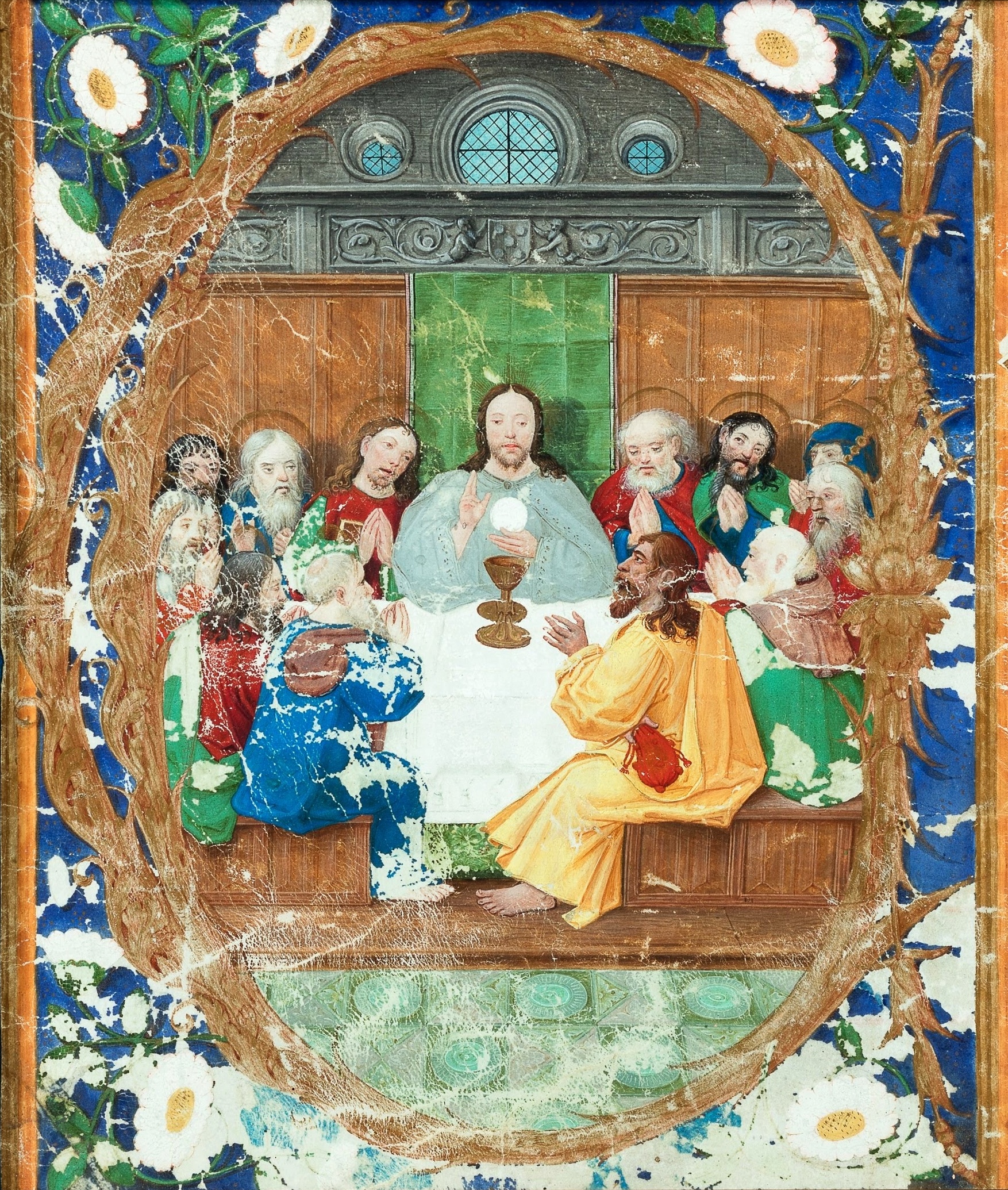
John's Gospel is packed with Jesus' teachings during the hours He gathered with His disciples to celebrate the Passover, Thursday evening of Holy Week. All through these teachings He constantly reminded His disciples that He was to die and that they would all desert Him. One of them would even betray Him. In that dark hour He was to fight His final battle with the ruler of this world. Yet even in His death He would not betray them whom He called His friends. So they must abide in Him as branches abide in the vine. His words must be held continually in their hearts. Then they would bear fruit as branches of the grapevine do (John 15:1-8).

Much of this they did not understand. Later, when the Spirit of truth came, He would guide them into the truth. Then they would see and understand: "A little while, and you will see me no longer; and again a little while, and you will see me" (John 16:16).

After Jesus' wonderful prayer to His Father (John 17:1-26), He went with them across the Kidron Valley to the Garden of Gethsemane to pray (John 18:1-2).


In all of this He says nothing about the Lord's Supper, mentioned so prominently in the other three Gospels. Or does He? Not in these chapters, but many feel that John records Jesus' teachings about the Supper in John 6 as He calls Himself the Bread of Life (John 6:48-51). In those verses He calls us all to look back to the story of ancient Israel's 40 years of wandering in the wilderness of Sinai.  All through those years they survived by eating the strange food called manna. The word is a question in Hebrew meaning, "What is it?" They never knew. All they knew was that it was there every morning and that it kept them alive until they entered the land of Canaan (Exodus 16:31-35; Numbers 11:6-9; Joshua 5:12).

The manna was very humbling. It taught them that they were totally dependent upon God's mercy, forgiveness and blessing. His creative Word produced it for them. It was not of their doing. They could not reproduce it nor save it. When they did it became rotten, stank and bred worms (Exodus 16:20). No it was their daily bread, nothing more, nothing less.

So Jesus describes Himself as our Bread of Life. His flesh is food indeed and His blood drink indeed (John 6:55). His flesh is for the life of the world. He who eats of it will not die as did the Israelites in the wilderness. Instead he will live forever! (John 6:51). Hard to believe, but that is the promise.

On this Thursday Christians around the world recall Jesus' institution of His Supper. We do not try to provide logical explanations for the meal. We do not analyze it. That's not its purpose. It is and will ever be a mystery. We eat of this bread and indeed it is bread. We drink of the wine, fruit of the vine. But over these earthly things He speaks His Words, "This is my Body . . . This is my Blood." And we each individually are nourished again for our personal journeys. We are assured that our sins are forgiven, forgotten and removed. So we go forth from the Supper renewed, strengthened for the next leg of our journey. And all the while we are confident that though our bodies will perish another mystery awaits us. This perishable, mortal body will be changed and we will put on immortality. Death will be swallowed up in the victory that is ours in our risen Lord (1 Corinthians 15:51-58):
"Therefore, my beloved brothers, be steadfast, immovable, always abounding in the work of the Lord, knowing that in the Lord your labor is not in vain."

Monday, March 7, 2011

The Leaven Of Immorality

"A little yeast works through the whole batch of dough" (Galatians 5:9). So writes the apostle Paul in a circular letter to the believers in the Roman province of Galatia. The analogy is clear, especially to those of us who bake bread. It doesn't take much yeast to make a loaf of bread rise. Likewise, it does not take many agitators to start a riot and it takes a relatively small number of people in a community to influence it for evil or for good. Examples abound.

In the congregations of Christians the same apostle began in Corinth, there was a man who had taken his father's wife (1 Corinthians 5:1-5). This was clearly an immoral sexual act, strictly forbidden by Holy Scripture (Genesis 49:4; Leviticus 18:8; Deut. 22:30, etc.). The Corinthian culture would not forbid such an act, filled as it was with the worship of many gods. The Corinthian Christians were influenced by their culture and had begun to feel their broad minded approach to sexual acts was the most loving, even if it was forbidden by ancient Israel's code of ethics. Paul pulls them up short with his analogy. "It won't be long," he warns, "before such thinking will influence your views on marriage, divorce, fornication, adultery and many other immoral acts. You must act at once. This man and his so-called wife are unrepentant. Make it clear by word and action that they are no longer welcome in your midst. Purge the leaven from the dough."

If you've paid attention and have been around more than a couple decades, you have surely noticed how the same thing is happening among modern Christians. Step by step, year by year, our views on sexual immorality have changed—and with them our views on marriage, home and family. As a Christian pastor I have noticed that a young couple planning marriage is exceptional that has not been sleeping together for some time and/or living together.

"Oh well, they are planning to get married, you know. And maybe it's best if they find out if they're compatible before they do get married. Besides, they don't plan to have children right away and have  been taking precautions." So we join the culture and rationalize the tragic erosion of Biblical ethics, ignoring almost everything that God's Word teaches about the meaning and purpose of the sexual relationship, marriage and family in the name of broad minded love.

The Lord Jesus warned his disciples by using the same analogy. Ignore the teaching of God's Law about the Christian life and obedience to the will of God and it will not be long before you deny the same Scripture's teaching about the Gospel and the person and work of Jesus Himself. "Watch and beware of the leaven of the legalistic Pharisees and the broad-minded Sadducees," he warned (Matthew 16:1-12).

The 40-day Lenten season we are about to enter is an excellent time for us to examine carefully our faith in Christ's sacrificial death upon the cross for us and our commitment to take up our own cross-responsibilities to follow Him.

Tuesday, June 2, 2009

Modern Life and Ancient Corinth

For the past year I've been leading a Bible study with a small group. We've been examining and discussing what the Apostle Paul wrote in his so-called first letter to the Corinthians. He wrote the letter about a generation after Christ's ministry. At that time there were hundreds in Galilee and Judea who had seen the Lord Jesus alive and present with them after His resurrection. Paul makes reference to that fact in the fifteenth chapter.

The Corinthians are so interesting because their problems have so many parallels in modern urban life, as well as the life in contemporary churches. Three individuals in particular, Stephanas, Fortunatus and Achaicus, come to Paul while he was teaching in Ephesus over on the eastern side of the Aegean Sea (modern Turkey). They told him they wanted to assist him with his work, but they may also have been the ones who carried news about predicaments in the several house churches there in Corinth.

I can imagine them saying, "Brother Paul, we have some real headaches, especially with one of our families. This man--dare we call him brother--is living with his step-mother. He claims it's perfectly legal and refuses to listen to anything we have to say. We're uncertain about how to proceed."

Perhaps Paul listened intently, asked some detailed questions and assured them he would be writing a letter. Was there anything else?

"Oh, yes," they replied. "We have a whole list of hurdles. Some are even questioning your right to claim the title of Apostle. They insist they follow Apollos. Others claim to be followers of Peter. And so it goes. They don't want to listen to anything you have to say."

"Interesting," mused Paul. "Continue."

And they did, listing controversies about church leadership, lawsuits, sexual experimentation, prostitution, marriage, idolatry, the Lord's Supper, worship, the work of the Holy Spirit and on and on.

Paul must have prayed for long hours for wisdom. How should he reply? Would they even bother to listen to what he had to say? After such musings and guided by the Holy Spirit, the Apostle wrote this wonderful letter to the believers scrattered around Corinth.

Corinth had a long history as a city and a city state, long before Paul's day. It was the home of more than 250,000 free persons, with nearly double that number of slaves. It was a harbor city, with commerce flowing back and forth across the isthmus upon which it was located. Greek to the hilt, controlled by the Romans, Corinth was home to a dozen pagan temples, many that sponsored religious prostitution. This was a center for open and unbridled immorality. At one time as many as a thousand sacred prostitutes served in the temple of Aphrodite.

In writing his letter, Paul deals with these and many other questions about morality, faith, religion, hope, life after death and the resurrection. As I said, it's a letter packed with vital and meaningful teachings that have scores of applications to modern life. I want to tackle what Paul writes and reflect upon it over the next months. Stay tuned.