Showing posts with label bread of life. Show all posts

Monday, July 1, 2013

Give Us This Day Our Daily Bread

Daily bread? Why bread? Why not, say, broccoli or carrots or cake? Why does our LORD teach us to pray, Give us this day our daily bread (Matt. 6:11) ? 

The fourth petition of the prayer our LORD taught us has a history, like everything else in the Bible. It goes back to the Exodus of the Children of Israel from bondage and slavery in Egypt in the 13th century B.C. Once they made it to the wilderness area between Egypt and the promised land they believed they were in big trouble. And they immediately began to complain about it.
And the whole congregation of the people of Israel grumbled against Moses and Aaron in the wilderness, and the people of Israel said to them, "Would that we had died by the hand of the LORD in the land of Egypt, when we sat by the meat pots and ate bread to the full, for you have brought us out into this wilderness to kill this whole assembly with hunger." - Exod. 16:2-3 ESV
The LORD's response to this grumbling disbelief was to "rain bread from heaven" for them. Every day they were to "gather a day's portion"—no more—so that the LORD might test their faith in Him and whether they were willing to walk in His commands. On the sixth day they were to gather twice as much, for on the seventh day they were to rest (Exod. 16:4-7, 21-27).

And what was this strange food that appeared with the morning dew? No one could tell. This is why they said to one another in Hebrew, "Man hu?" What is it?
Moses reply was simple and to the point,

"It is the bread that the LORD has given you to eat. This is what the LORD has commanded: 'Gather of it, each one of you, as much as he can eat. You shall each take an , according to the number of the persons that each of you has in his tent.'" - Exod. 16:15-16 ESV 
omer
An omer was equal to a couple quarts in our terms. Some gathered more, some less, but they discovered that whoever gathered much had nothing left over for the next day and whoever gathered little had quite enough nevertheless. Some tried to save it over to the next day, but they soon found that it bred worms and stank. And they also learned that it melted in the sun's heat. So it was a day by day existence. They were completely dependent upon the blessings of the LORD, for there was little else to eat in that wild, deserted area.

Many have offered guesses about Manna, but they remain but guesses. Here is one such, based upon a 2010 NY Times article.
The Bible describes it as being “like coriander seed,” and “white, and its taste was like wafers with honey.” 
But as miraculous as its biblical apparition may seem, manna is real and some chefs have been cooking with it. 
The dozens of varieties of what are called mannas have two things in common. They are sweet and, as in the Bible, they appear as if delivered by providence, without cultivation. 
Most of this manna is either dried plant sap extruded from tiny holes chewed out by almost invisible bugs, or a honeydew excreted by bugs that eat the sap. 
Rarer are the mannas not from sap, including Trehala manna, the sweet-tasting cocoon of the Larinus maculates beetle from Turkey; and manna-lichen (Lecanora esculenta), which occasionally dries up and blows around to form semisweet clouds out of which manna settles into drifts from western Greece to the central Asian steppe. 
Mannas form best in extremely dry climates — like the Middle East’s — where sap oozes at night and dries up in the morning. The favored theory on what the Israelites called manna is the sap of a tamarisk tree. 
In Calabria and Sicily, Italian farmers cut the bark of the flowering ash (Fraxinus ornus) to get the dried sap, the only domesticated form of manna. Italian apothecaries used it for centuries as a laxative, and other mannas have been used for medicinal purposes.
I suppose its OK to claim to know what Manna was. The real point is that it was always there for them throughout the 40 years before they claimed the land promised to Abraham and his descendants (Genesis 13:14-18).

Jesus' prayer for today's bread has all this in mind. More about this in my next post.

Wednesday, September 12, 2012

Christian Cannibalism

What shall we do with Jesus' words in John 6 about bread and blood? Across the centuries that mark the existence of the Christian church this has been a central question.
The Jews then disputed among themselves, saying, "How can this man give us his flesh to eat?" So Jesus said to them, "Truly, truly, I say to you, unless you eat the flesh of the Son of Man and drink his blood, you have no life in you. Whoever feeds on my flesh and drinks my blood has eternal life, and I will raise him up on the last day. For my flesh is true food, and my blood is true drink. Whoever feeds on my flesh and drinks my blood abides in me, and I in him. - Jhn 6:52-56 ESV
Did Jesus truly speak in this instance about his flesh and blood? And did he suggest a literal eating of his flesh and drinking of his blood? Early Christians were accused of such cannibalism.
Now the story about the initiation of young novices is as much to be detested as it is well known. An infant covered over with meal, that it may deceive the unwary, is placed before him who is to be stained with their rites: this infant is slain by the young pupil, who has been urged on as if to harmless blows on the surface of the meal, with dark and secret wounds. Thirstily - O horror! they lick up its blood; eagerly they divide its limbs. By this victim they are pledged together; with this consciousness of wickedness they are covenanted to mutual silence. -Octavius (Minucius Felix), chp.IX

The charge of ritual cannibalism was probably based on confused accounts of the Christian eucharist. Hippolytus of Rome tells us what actually went on at a Christian service. Words from his early eucharistic prayer, still used in some churches, date from the beginning of the third century.
". . . Mindful therefore of his death and resurrection, we offer you this bread and cup, giving thanks to you because you have found us worthy to stand before you and serve you. And we beg you to send the Holy Spirit upon the offering of the holy church and gather into one all who have received it . . . that we may praise and glorify you through your son Jesus Christ, through whom is glory and honor to the Father and the Son and the Holy Spirit, in your holy church both now and forever. Amen."
John's Gospel does not specifically record Jesus' establishing the Supper. Since John wrote after the destruction of Jerusalem in 70 A.D. there was no need. The other Gospels have this account (Matt. 26:26-28; Luke 22:17-20). John's task was to deepen believers' understanding of the Eucharist and to invite meditation upon Jesus' discussion of himself as the Bread of life. However, great problems arose over such meditation across the centuries as men sought to solve the Jewish question:
The Jews then disputed among themselves, saying, "How can this man give us his flesh to eat?"
As a result of such attempts we have long philosophical essays, thousands of sermons, pronouncements by church councils, arguments and threats leading to wars, murders, the destruction of property and on and on. Here are but a few of the questions that have arisen.

Is the Eucharistic bread and wine truly the body and blood of Christ? And if so, how is this possible? Does a miracle happen when the words of Christ are spoken by the priest or pastor presiding over the gathering of believers so that the very substance of the bread and wine are changed into the body and blood of Christ? Granted, the bread and wine still look, taste and feel as before, but have they indeed changed? And if so, does this transformed bread and wine remain as the body and blood of Christ even after the Eucharistic celebration has ended? And does that mean that believers should worship these elements, kneel before them, even pray to them, because they are the presence of the living Christ? Is such a celebration a sacrifice anew of Christ's body and blood, even though blood is not again shed?

I will not offer answers to all these and many other related questions in this short blog. If you want to explore them in great detail (at least from a Lutheran viewpoint) I point you to an excellent book: The Lord's Supper by John R. Stephenson (2003 by The Luther Academy). Here is Dr. Stephenson's conclusion.
"The torrent of our human words, whether wise or foolish, pious or ungodly, must subside before the majesty of the words, deeds, and very being of the Word made flesh for our sakes. Luther once noted the apostles' silence as Jesus founded the Blessed Sacrament—"Here they keep silent and simply believe." Before and after all our proclamation and catechesis, their successors in office do well to hold our tongues with the Twelve. They briefly reclined with their Lord at table, and we spend long hours seated at our desks in study. True theology, which is a pondering (Luke 2:51) and keeping (Luke 8:21) of the Word to be practiced by laity as well as clergy, fitly moves from a seated to a kneeling posture as we realize how "My help comes from the Lord, who made heaven and earth" (Ps. 121:2). With the Magi, we fall in worship befrore our enfleshed God (Matt. 2:11). 
With other afflicted children of our first parents, we kneel to crave His aid (Matt. 8:2). With Peter, James, and John, we adore in Him the embodied beauty of God (Matt. 17:6).  True theology rejects any separation of study from piety, for the two become one in the single, two-sided reality of passive and active worship. As our minds begin by God's gift to grasp Jesus' real identity and our souls contemplate the love that He keeps on lavishing upon us (John 15:9), we shall share to the full Luther's heartfelt love of "this dear, blessed Supper." When awe-filled silence gives way to speech and song, we can do no other than cry out with our forbears in the Church of the Augsburg Confess, "For thy consoling Supper, Lord, / Be praised throughout all ages!" 


Tuesday, September 11, 2012

The Mystery Of Jesus' Body And Blood

We continue our study of John 6, especially these words of Jesus:
I am the living bread that came down from heaven. If anyone eats of this bread, he will live forever. And the bread that I will give for the life of the world is my flesh." The Jews then disputed among themselves, saying, "How can this man give us his flesh to eat?" So Jesus said to them, "Truly, truly, I say to you, unless you eat the flesh of the Son of Man and drink his blood, you have no life in you. Whoever feeds on my flesh and drinks my blood has eternal life, and I will raise him up on the last day. For my flesh is true food, and my blood is true drink. Whoever feeds on my flesh and drinks my blood abides in me, and I in him. As the living Father sent me, and I live because of the Father, so whoever feeds on me, he also will live because of me. This is the bread that came down from heaven, not like the bread the fathers ate and died. Whoever feeds on this bread will live forever." - Jhn 6:51-58 ESV
The longing for immortality continues. It always will. This longing also serves as a strong entertainment theme. Last year the movie The Immortals was a big hit. Once again Hollywood drew upon Greek mythology to portray a mortal man, Theseus, chosen by Zeus to lead the fight against the ruthless King Hyperion, who is on a rampage across Greece to obtain a weapon that can destroy humanity. 

We who follow Jesus know the true name of the king on a rampage across the planet. He indeed has a weapon that not only can, but is destroying humanity. Satan's weapon is sin. He tempts us all to rebel against our true King. He began to wield his weapon as the first man and first woman appeared in the Garden (Gen. 3:1-27). As a result all of us are denied access to Eden and the tree of life. Our Creator's curse is upon us (Gen. 2:16-17). We all die since we all are descended from Adam and Eve. The Apostle puts it this way,
For as by a man came death, by a man has come also the resurrection of the dead. For as in Adam all die, so also in Christ shall all be made alive. - 1 Cor 15:21-22 ESV
 As in Adam all die . . . What does Paul mean when he says we are all in Adam? Is he saying that we are all descended from this one man? At this point I won't get into any discussion about evolution, etc. I've done that earlier. Indeed, Paul's point is that all men can trace their lineage back to Adam and his wife Eve. In that sense, Christ Jesus is the Second Adam. In speaking about how we will be filled with and controlled by the Holy Spirit in the resurrection, Paul continues,
Thus it is written, "The first man Adam became a living being"(Gen 2:7); the last Adam became a life-giving spirit. But it is not the spiritual that is first but the natural, and then the spiritual. The first man was from the earth, a man of dust; the second man is from heaven. As was the man of dust, so also are those who are of the dust, and as is the man of heaven, so also are those who are of heaven. Just as we have borne the image of the man of dust, we shall also bear the image of the man of heaven. - 1 Cor 15:45-49 ESV
We know much about DNA and genetics in our day. Consequently, it is no longer difficult to conceive of a man or woman passing on to his or her descendants various physical characteristics, as well as tendencies to develop various diseases. In that sense, I bear the image of my father. I look very much like him. I also have developed heart disease, just as he and as my maternal grandfather did. So it goes on the physical level. 

Paul writes about another level of human existence, namely the inner life of a man, his soul if you will. We are by nature sinful, inwardly filled with the desire to disobey the commands of God to love only Him and to love others as ourselves (Ps. 51:5; 58:3; Eph 2:1-3). This is the course and direction of the entire world of man. In that sense we all are children of Adam and the curse of death rests upon us as it did upon our father Adam. We bear his image.
By the sweat of your face you shall eat bread, till you return to the ground, for out of it you were taken; for you are dust, and to dust you shall return." - Gen 3:19 ESV
Jesus came to change all of this. He is the Bread from heaven and whoever feeds on him will live forever. As he said,
Whoever feeds on my flesh and drinks my blood has eternal life, and I will raise him up on the last day. For my flesh is true food, and my blood is true drink. Whoever feeds on my flesh and drinks my blood abides in me, and I in him. As the living Father sent me, and I live because of the Father, so whoever feeds on me, he also will live because of me.
What does it possibly mean to eat his flesh and drink his blood? Is this figurative or literal language? My answer is Yes! It is both, for we are dealing with a paradox, a mystery as profound and wondrous as the fact that Jesus is both God and Man! Were he but a man, his sacrificial death would never suffice as payment for the sins of the entire world. Yet Jesus himself said he came to offer his life as the ransom for all men's sins (Matt. 20:28). And Paul concludes
. . . that one has died for all, therefore all have died; and he died for all, that those who live might no longer live for themselves but for him who for their sake died and was raised. - 2 Cor 5:14-15 ESV
For this to be possible, he must also be God, very God of very God, of one substance with the Father, as the Father himself said: this is my beloved Son (Matt. 3:17; 17:5. See the Nicene creed ). He bears the image of his Father (Col. 1:15). Thus he is the Bread that came down from heaven and whoever believes on him will be saved (1 Tim. 4:10). In that sense to believe in him is to eat his flesh and drink his blood.

But there is more to this mystery. Jesus took the bread of the Passover, broke it and give it to his disciples and said,
"Take, eat; this is my body." And he took a cup, and when he had given thanks he gave it to them, saying, "Drink of it, all of you, for this is my blood of the covenant, which is poured out for many for the forgiveness of sins." - Matt 26:26-28 ESV
Is this also a figure of speech? More on this profound mystery next time.


Wednesday, September 5, 2012

Some Hard Words Of Jesus

If you're familiar with Bible stories at all, you've heard about Manna, that strange bread that the Children of Israel found on the ground each morning during their 40 years of wandering in the Sinai peninsula. But what was it? And that's the very point. We don't know what it was. In fact, that's is what the Hebrew word Manna means, what is it?

Of course there are many speculations and attempts to find some kind of natural explanation for what was going on. Here's what the Bible says about it.

And when the dew had gone up, there was on the face of the wilderness a fine, flake-like thing, fine as frost on the ground.When the people of Israel saw it, they said to one another, "What is it?" (Hebrew man hu) For they did not know what it was. And Moses said to them, "It is the bread that the LORD has given you to eat. . . When the people of Israel saw it, they said to one another, "What is it?" For they did not know what it was. And Moses said to them, "It is the bread that the LORD has given you to eat. ... 
Now the house of Israel called its name manna. It was like coriander seed, white, and the taste of it was like wafers made with honey. 
Moses said, "This is what the LORD has commanded: 'Let an omer of it be kept throughout your generations, so that they may see the bread with which I fed you in the wilderness, when I brought you out of the land of Egypt.'" And Moses said to Aaron, "Take a jar, and put an omer of manna in it, and place it before the LORD to be kept throughout your generations." As the LORD commanded Moses, so Aaron placed it before the testimony to be kept. 
The people of Israel ate the manna forty years, till they came to a habitable land. They ate the manna till they came to the border of the land of Canaan. - Exd 16:14-15, 31-35 ESV
Now the manna was like coriander seed, and its appearance like that of bdellium (resin). The people went about and gathered it and ground it in handmills or beat it in mortars and boiled it in pots and made cakes of it. And the taste of it was like the taste of cakes baked with oil. - Num 11:7-8 ESV
And the manna ceased the day after they ate of the produce of the land. And there was no longer manna for the people of Israel, but they ate of the fruit of the land of Canaan that year. - Jos 5:12 ESV

The Wikipedia article offers scholarly attempts to provide a natural explanation for Manna.
Some scholars have proposed that manna is cognate with the Egyptian term mennu, meaning "food".[13] At the turn of the twentieth century, Arabs of the Sinai Peninsula were selling resin from the tamarisk tree as man es-simma, roughly meaning "heavenly manna".[12] Tamarisk trees (particularly Tamarix gallica) were once comparatively extensive throughout the southern Sinai, and their resin is similar to wax, melts in the sun, is sweet and aromatic (like honey), and has a dirty-yellow color, fitting somewhat with the Biblical descriptions of manna.[14][15] However, this resin is mostly composed from sugar, so it would be unlikely to provide sufficient nutrition for a population to survive over long periods of time,[14] and it would be very difficult for it to have been compacted to become cakes.[15]
So back to Jesus' argument with the people who followed him after he had provided bread for thousands out in the wilderness north of the Sea of Galilee as recorded in John 6. They pointed to the Manna provided to the people of the Exodus. Jesus' response:
I am the bread of life. Your fathers ate the manna in the wilderness, and they died. This is the bread that comes down from heaven, so that one may eat of it and not die. I am the living bread that came down from heaven. If anyone eats of this bread, he will live forever. And the bread that I will give for the life of the world is my flesh." - Jhn 6:48-51 ESV
When the people heard him say this they took it literally and began to dispute among themselves, saying, "How can this man give us his flesh to eat?" - Jhn 6:52 ESV. Jesus made no attempt to correct their understanding. He simply said
"Truly, truly, I say to you, unless you eat the flesh of the Son of Man and drink his blood, you have no life in you. Whoever feeds on my flesh and drinks my blood has eternal life, and I will raise him up on the last day. For my flesh is true food, and my blood is true drink. Whoever feeds on my flesh and drinks my blood abides in me, and I in him. As the living Father sent me, and I live because of the Father, so whoever feeds on me, he also will live because of me. This is the bread that came down from heaven,not like the bread the fathers ate and died. Whoever feeds on this bread will live forever." - Jhn 6:53-58 ESV
So there it is—right in the face of the people who followed Jesus to Capernaum after the sign he had provided by feeding thousands. Did he literally feed thousands with five loaves of bread and two small fish from a little boy's lunch? There was no natural explanation for it, even though many unbelievers have suggested such silly things as that he gave them an example and so encouraged people to share their lunches with one another. Those who came after him to Capernaum knew otherwise. They did not dispute the wonder. They had witnessed it and wanted Jesus to do it again and again. The feeding had literally happened.

And now Jesus is literally saying, "Whoever feeds on my flesh and drinks my blood has eternal life, and I will raise him up on the last day. For my flesh is true food, and my blood is true drink. Whoever feeds on my flesh and drinks my blood abides in me, and I in him."

Is there any indication in John's account of Jesus' words that we should take this in any other manner than literal? The Israelites literally ate Manna, even though they did not know what it was. That bread literally sustained them for all forty years of their journey and it stopped as soon as they crossed the Jordan river. No one, neither the Jews of Capernaum nor Jesus disputed it.

Likewise, nobody argued with Jesus about what he had done. He literally fed thousands and thousands of people with a little boy's lunch. This is why they wanted to make him their king. No more working for food. With Jesus as the head of this new government, all they had to do was line up and accept the daily handout. The miraculous Manna would once again be available. What a deal!

So now when Jesus says that he is the Bread that provides eternal life, where do we find the right to say he's talking symbolically or in picture language? It certainly sounds like he means us to take him literally, like he really does want us to eat his flesh and drink his blood. At least that's how the text reads.

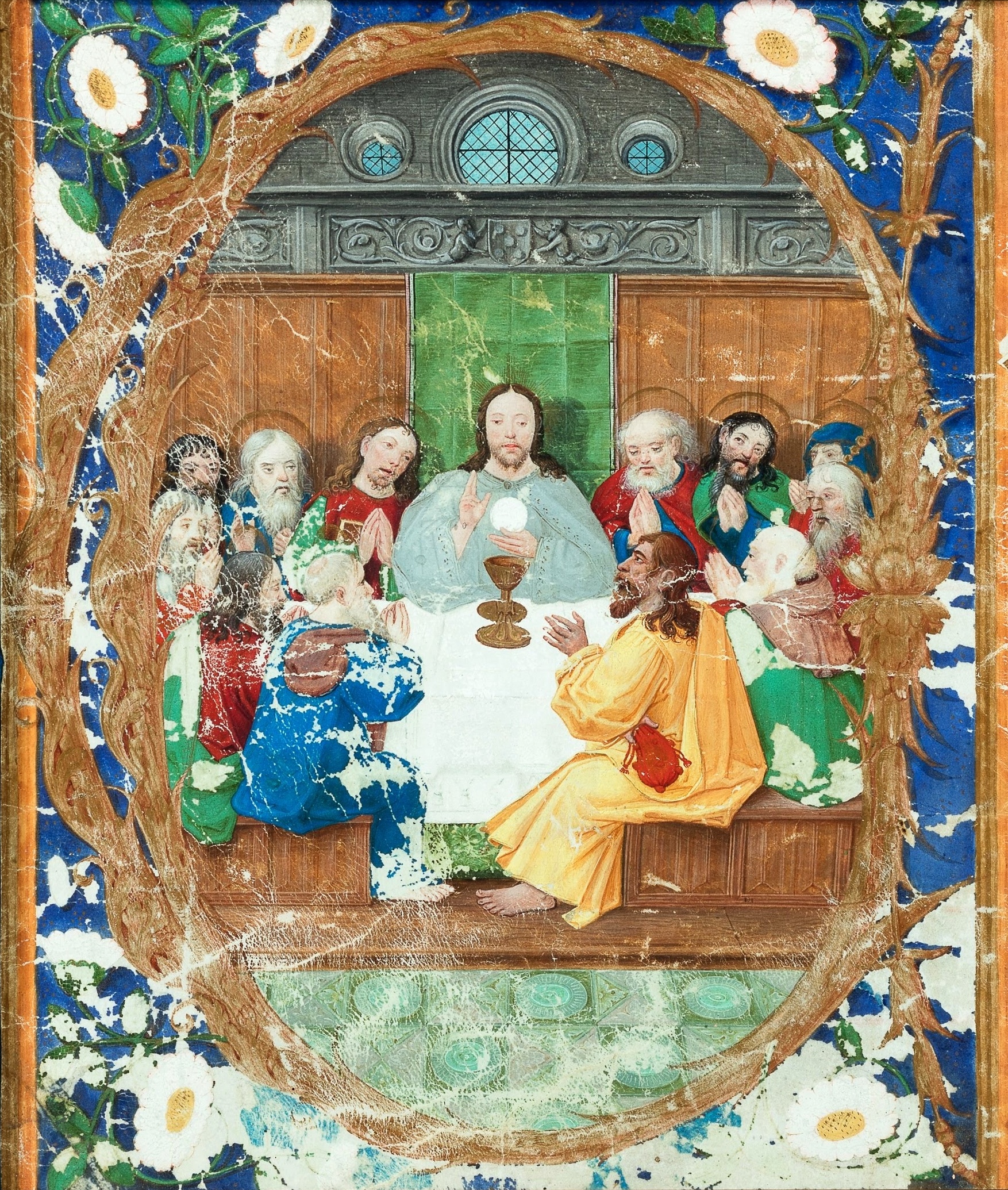
It also appears that this is John's account of Jesus pointing to what was later called the Lord's Supper in which, as Jesus and his disciples were eating the Passover, he took unleavened bread, and after blessing it broke it and gave it to them, and said,
"Take, eat; this is my body." And he took a cup, and when he had given thanks he gave it to them, saying, "Drink of it, all of you, for this is my blood of the covenant, which is poured out for many for the forgiveness of sins. I tell you I will not drink again of this fruit of the vine until that day when I drink it new with you in my Father's kingdom." - Mat 26:26-29 ESV

So we're facing the same dilemma as many of his disciples at Capernaum. When they heard his words, they said, "This is a hard saying; who can listen to it?" - Jhn 6:60 ESV

A hard saying indeed. Who can listen to words that seem literally to say eat my flesh and drink my blood? It just doesn't make sense. There has to be another explanation, a more natural one. Many, many disciples of Jesus right up to the present day try very, very hard to soften his words.

We'll have to pursue these hard words next time.


Tuesday, September 4, 2012

Who Wants Life On Mars Without Life On Earth?

William Whewell was the natural philosopher at Trinity College, Cambridge back in the middle of the 19th century who proposed the term scientist to describe the study of the world of nature. He also suggested that the planet Mars had seas, land and even some kind of life. In the beginning of the 20th century Percival Lowell in his book Mars and Its Canals, proposed that Mars' canals were the work of a long-gone civilization. Speculation about life on Mars was rampant in those years. Science fiction writer H.G. Wells wrote his famous War of the Worlds in 1897 and the idea spread. 

On Sunday, Oct. 30, 1938 Orson Wells shocked the world with a fake Halloween radio broadcast, adapting H.G. Wells' book, to announce that the Martians had indeed arrived. People hearing the broadcast panicked as they learned of the ferocious, unstoppable attack of the Martians upon our planet. Many fled their homes in terror. 

The search for life on Mars continues in our day as NASA guides the rover Curiosity to search for signs of life on the surface of the red planet. And if our scientists find that life of some sort is possible there, what then? 

Many fed by Jesus on the shores of the Sea of Galilee pursued life as well. Following Jesus across the sea they still wanted him to be their king. His reply was,  
"Truly, truly, I say to you, you are seeking me, not because you saw signs, but because you ate your fill of the loaves. Do not labor for the food that perishes, but for the food that endures to eternal life, which the Son of Man will give to you. For on him God the Father has set his seal." - Jhn 6:26-27 ESV
Food that endures to eternal life?

Jesus distinguished between two types of life with his remark. The people who pursued him were concerned primarily about their bodily or biological life, life sustained by the loaves and fishes he had supplied. However, such bread grows old and stale. Dried fish, commonly used for food in those days, ultimately becomes inedible. This was food that perishes. Instead of such food, Jesus offered them the food that endures to eternal life.

Note that Jesus calls himself the Son of Man. The phrase would normally cause one to think about Jesus as a human, which indeed he was. So King David wrote,
What is man that you are mindful of him, and the son of man that you care for him? - Psa 8:4 ESV
But there was another strange use of the term in the the prophecy of Daniel.
"I saw in the night visions, and behold, with the clouds of heaven there came one like a son of man, and he came to the Ancient of Days and was presented before him. And to him was given dominion and glory and a kingdom, that all peoples, nations, and languages should serve him; his dominion is an everlasting dominion, which shall not pass away, and his kingdom one that shall not be destroyed. - Dan 7:13-14 ESV
Daniel saw a human being to whom God, the Ancient of Days, gave an everlasting kingdom. All people on earth would serve this son of man forever. How could this be? Only God is eternal. No man dare claim an eternal kingdom. And yet, writes Daniel, this is what I saw God give this son of man.
"King? Dominion? Eternal life? Yes, but you people don't get it," said Jesus. "Instead, all you can think about is this bread you ate yesterday, this food that perishes. All you want is another hand-out. Look at the sign I gave you! What I did was a sign from my Father, a sign that He sent me to give you life, eternal life."
But they paid no attention. They wouldn't believe him. Instead they continued to believe they had to do something.

"What must we do, to be doing the works of God?" 
Jesus answered them, "This is the work of God, that you believe in him whom he has sent." 
So they said to him, "Then what sign do you do, that we may see and believe you? What work do you perform? Our fathers ate the manna in the wilderness; as it is written, 'He gave them bread from heaven to eat.'" 
Jesus then said to them, "Truly, truly, I say to you, it was not Moses who gave you the bread from heaven, but my Father gives you the true bread from heaven. For the bread of God is he who comes down from heaven and gives life to the world." - Jhn 6:28-33 ESV
No, you don't have to fly to Mars. You don't have to spend billions to discover if there is life on the red planet or somewhere else in the universe. Life is right here on earth. The Son of Man has come down from heaven to give it to everyone. He is the bread of God who gives life, eternal life, life without end.
"Aha! Now you're talking, Son of Man," they said. "You really are a bread-king. Sir, give us this bread always." - Jhn 6:34 ESV
But they still didn't get it. Do you? We'll pick up the conversation next time. We need to take a look at Manna, this strange bread for the journey that the Lord gave his people in the wilderness.


Tuesday, August 14, 2012

Feeding The Whole Man, Both Soul And Body

I'm discussing the meaning of discipleship in the light of John's Gospel, particularly John 6 and the story of Jesus feeding thousands in the wilderness.

Lifting up his eyes, then, and seeing that a large crowd was coming toward him, Jesus said to Philip, "Where are we to buy bread, so that these people may eat?" He said this to test him, for he himself knew what he would do. 
Philip answered him, "Two hundred denarii would not buy enough bread for each of them to get a little." 
One of his disciples, Andrew, Simon Peter's brother, said to him, "There is a boy here who has five barley loaves and two fish, but what are they for so many?" 
Jesus said, "Have the people sit down." Now there was much grass in the place. So the men sat down, about five thousand in number. - Jhn 6:5-10 ESV
As noted in yesterday's Gospel, Philip was called by Jesus to be one of His disciples. He was from Bethsaida on the northern coast of the inland Sea of Galilee, the same town where Andrew and Peter lived. Philip introduced Nathanael to Jesus. Unlike the other disciples, Philip had a Greek name, implying some connection to the Greek speaking community of that multi-cultural region of Palestine. Later in John's Gospel Philip introduced members of this community to Jesus (John 14:8-11). We must assume that mixed among this crowd that followed Jesus out into the wilderness were Greek speaking people, perhaps many who were not even Jews. This may well explain why Jesus approached Philip first to ask him how they might feed such a large crowd.

But why be concerned about feeding the crowd at all? For the same reasons that Jesus was concerned about healing.

Back in the 1940s and 50s a psychologist by the name of Abraham Maslow introduced something he called the Hierarchy of Needs. These ideas were presented in his book Motivation and Personality, first published in 1954 and now available as an e-book. Maslow's theory is that basic to all human existence are the primary physiological and biological needs for air, food, shelter, warmth, sex, etc. Only as these are satisfied are people motivated to seek higher levels of need. This hierarchy is often presented in diagram format.

From Wikipedia: Maslow's hierarchy of needs

Keeping this understanding of human psychology in mind, it seems safe to conclude that our Lord Jesus was saying two things when he approached first Philip and through him the rest of the disciples.
  1. There are people here who are not Jews. Philip, you know that better than the rest of us. You speak Greek, you have relatives among them. It doesn't matter that they don't speak Aramaic like the rest of us or that they may be Greeks, Romans, Syrians or even Samaritans. They're hungry and in need. We must care for them. How shall we do this?
  2. Consider especially their physiological and safety needs. We must care for them or they'll never pay attention to their need to believe in Me, Jesus, their Lord, Savior and King. 
And with that I strongly urge all of us who are Christians and followers of Jesus to recognize the strategy of Jesus in reaching out to people. He has established the basic and fundamental model for all of us involved in His mission to reach the lost. In the name of love we cannot ignore all people's basic needs for food, shelter and sleep. Immediately following that are the needs for security and health for individuals and for their families. If we are indeed the Body of Christ, His arms and hands in our communities, then we must indeed be concerned for these fundamental needs of all, whether in the church or outside it. With these satisfied or cared for, people will be motivated to concern themselves with higher needs. Then we feed their souls as well.  

Jesus always cared for the whole person. Likewise this has always been the concern of the church, the living, active body of Christ in this world. Across the centuries this has led the church to establish hospitals and clinics, to feed the hungry, provide clothing and shelter for those in need and on and on and on. And along with these commitments to care for the body, the church brings the teaching of God's Word so that we may feed men with the Bread of Life (John 6:35-48), Jesus, Savior of the world and care for their spiritual needs. The two types of feeding, the feeding of both body and soul, are inter-connected and can never be separated one from the other. 

More about this in my next post as I continue this discussion of discipleship. 

Friday, April 29, 2011

Give Us Tomorrow's Bread

For a variety of reasons I have been anxious and troubled of late. Perhaps it has to do with age. It has nothing to do with health, for the Lord continues to grant me good health. Yet I find myself projecting into the future with such thoughts like, How long have I yet to live? Will I grow ill one day and die from the illness? Will someone have to care for me as my strength ebbs? And other nonsense such as this.

So I return each day to the Lord's Prayer and pray again, "Give us this day our daily bread." Yet as I do so I wonder if I really understand what I am saying. What is this daily bread for which I am asking?

I am quite content with Martin Luther's explanation of daily bread. It is everything that belongs to the needs of the body, such as food, clothing, good weather, health, home, wife, children, good government and so forth. So it was that Joseph invited his brothers to his home to eat bread with him long after they had sold him into slavery and he had become chancellor of Egypt (Genesis 43:24). Bread is all that we need to care for us. My concern is not with what the word bread refers to, but with the fact that I and others find ourselves being anxious and troubled about tomorrow's bread and the bread we'll need years far into the future.

Jesus addressed this in His Sermon when he said,
And which of you by being anxious can add a single hour to his span of life? And why are you anxious about clothing? Consider the lilies of the field, how they grow: they neither toil nor spin, yet I tell you, even Solomon in all his glory was not arrayed like one of these. But if God so clothes the grass of the field, which today is alive and tomorrow is thrown into the oven, will he not much more clothe you, O you of little faith? Therefore do not be anxious, saying, 'What shall we eat?' or 'What shall we drink?' or 'What shall we wear?' For the Gentiles seek after all these things, and your heavenly Father knows that you need them all. But seek first the kingdom of God and his righteousness, and all these things will be added to you.
 "Therefore do not be anxious about tomorrow, for tomorrow will be anxious for itself. Sufficient for the day is its own trouble (Matthew 6:27-34).
As I read this admonition I thought about the Manna that the Israelites were provided during the 40 years of their wanderings in the wilderness and Paul reminding us that this history was written for our instruction (I Cor. 10:11). One of the things that struck me was that they were forbidden to search for Manna on the seventh day, the Sabbath, the day of rest. Then I recalled that Jesus died on Friday, the sixth day, as He said, "It is finished." He rested from His labor on the seventh day, the Sabbath. From His completed work we have received the bread we need for our journeys. Jesus is our living bread of God come down from heaven (John 6:51).

On the night Jesus was betrayed, as the sixth day began with the setting of the sun, He took bread and gave it to His disciples, saying, "Take eat. This is my body"(Matthew 26:26). In turn, John invites us to reflect on how Jesus fed thousands in the wilderness with a boy's lunch. Later Jesus rebuked the crowds that followed as He said,
"Do not labor for the food that perishes, but for the food that endures to eternal life, which the Son of Man will give to you. For on Him God the Father has set His seal" (John 6:27). 
In this faith and with this Word, I return to the prayer and the phrase daily bread. The word daily must refer to the most immediate day before us, the day we are about to come upon. So Luke, using the same Greek phrase, wrote in Acts
"So, setting sail from Troas, we made a direct voyage to Samothrace, and the following day to Neapolis" (Acts 16:11). 
So we may pray to our Father to give us the following day's bread and know with certainty that He will, because we are His children in Christ, the true Bread of life. We are children of the Kingdom. He will take care of tomorrow. On the day before us our Father will provide. We are free to focus upon the troubles and challenges of today. That is all we need to concern ourselves with. Knowing this, anxiety melts away. 

Thursday, April 21, 2011

Your Labor Is Not In Vain

John's Gospel is packed with Jesus' teachings during the hours He gathered with His disciples to celebrate the Passover, Thursday evening of Holy Week. All through these teachings He constantly reminded His disciples that He was to die and that they would all desert Him. One of them would even betray Him. In that dark hour He was to fight His final battle with the ruler of this world. Yet even in His death He would not betray them whom He called His friends. So they must abide in Him as branches abide in the vine. His words must be held continually in their hearts. Then they would bear fruit as branches of the grapevine do (John 15:1-8).

Much of this they did not understand. Later, when the Spirit of truth came, He would guide them into the truth. Then they would see and understand: "A little while, and you will see me no longer; and again a little while, and you will see me" (John 16:16).

After Jesus' wonderful prayer to His Father (John 17:1-26), He went with them across the Kidron Valley to the Garden of Gethsemane to pray (John 18:1-2).


In all of this He says nothing about the Lord's Supper, mentioned so prominently in the other three Gospels. Or does He? Not in these chapters, but many feel that John records Jesus' teachings about the Supper in John 6 as He calls Himself the Bread of Life (John 6:48-51). In those verses He calls us all to look back to the story of ancient Israel's 40 years of wandering in the wilderness of Sinai.  All through those years they survived by eating the strange food called manna. The word is a question in Hebrew meaning, "What is it?" They never knew. All they knew was that it was there every morning and that it kept them alive until they entered the land of Canaan (Exodus 16:31-35; Numbers 11:6-9; Joshua 5:12).

The manna was very humbling. It taught them that they were totally dependent upon God's mercy, forgiveness and blessing. His creative Word produced it for them. It was not of their doing. They could not reproduce it nor save it. When they did it became rotten, stank and bred worms (Exodus 16:20). No it was their daily bread, nothing more, nothing less.

So Jesus describes Himself as our Bread of Life. His flesh is food indeed and His blood drink indeed (John 6:55). His flesh is for the life of the world. He who eats of it will not die as did the Israelites in the wilderness. Instead he will live forever! (John 6:51). Hard to believe, but that is the promise.

On this Thursday Christians around the world recall Jesus' institution of His Supper. We do not try to provide logical explanations for the meal. We do not analyze it. That's not its purpose. It is and will ever be a mystery. We eat of this bread and indeed it is bread. We drink of the wine, fruit of the vine. But over these earthly things He speaks His Words, "This is my Body . . . This is my Blood." And we each individually are nourished again for our personal journeys. We are assured that our sins are forgiven, forgotten and removed. So we go forth from the Supper renewed, strengthened for the next leg of our journey. And all the while we are confident that though our bodies will perish another mystery awaits us. This perishable, mortal body will be changed and we will put on immortality. Death will be swallowed up in the victory that is ours in our risen Lord (1 Corinthians 15:51-58):
"Therefore, my beloved brothers, be steadfast, immovable, always abounding in the work of the Lord, knowing that in the Lord your labor is not in vain."