Showing posts with label manna. Show all posts

Tuesday, July 7, 2015

The Hidden Manna And The White Stone

In my area of suburban Houston there is a Christian counseling service that calls itself Whitestone Associates. It is led by a psychiatrist, Dr. Paul Looney.

In the letter to the church in Pergamum the Spirit refers to the white stone in this way:
He who has an ear, let him hear what the Spirit says to the churches. To the one who conquers I will give some of the hidden manna, and I will give him a white stone, with a new name written on the stone that no one knows except the one who receives it.' - Rev 2:17 ESV 
Manna, as most of us know, was the mysterious food that appeared each morning on the ground as the Children of Israel made their way to the promised land (Exod 16:32-34). The word may be translated into English as "what is it?" They knew not whence it came nor why. They only knew that the LORD supplied their daily needs. In like manner these believers would conquer by God's power and be privileged to eat the hidden manna. It is not visible now, but will be available in abundance when they are blessed in that great day to eat the Bread of life forever (John 6:30-35). Jesus, the great I AM, is that Bread of life (John 6:48-58). Those who feed on Him will live forever.

 Besides the hidden manna, the Risen Christ promises to give them each a white stone with a new name written on it. White is a symbol of holiness (Rev. 1:14; 3:4-5,18). A white stone was often prized in those days as an amulet, an object with power to protect its wearer from harm, especially if it had the name or image of some deity engraved on it or was a mark of membership in a special group. We cannot tell for certain what John's revelation implies, but it seems that in the future, when they conquer in the name of Jesus, believers will receive their own white stone, known only to the conqueror (Rev. 19:12), the secret name of Jesus. They will then be granted entrance into His eternal kingdom. By grace even eunuchs and foreigners will be accepted into the LORD's house of prayer.
And the foreigners who join themselves to the LORD, to minister to him, to love the name of the LORD, and to be his servants, everyone who keeps the Sabbath and does not profane it, and holds fast my covenant—these I will bring to my holy mountain, and make them joyful in my house of prayer; their burnt offerings and their sacrifices will be accepted on my altar; for my house shall be called a house of prayer for all peoples." - Isa 56:6-7 ESV 
Priest-Martyr Antipas Commemorated April 11
Such are the promises of "him who has the sharp two-edged sword" (Rev. 1:16; 2:16; Hebr 4:12). His Word is all-powerful. It reveals the deepest motives of the heart. And there in Pergamum were those who did not deny faith in the Risen Christ "even in the days of Antipas, my witness." We are not told who this Antipas was, because this is the only Biblical reference to him. There is, however, a tradition that says that John the Apostle ordained Antipas as the Bishop of Pergamum during the reign of Roman Emperor Domitian. According to this tradition Antipas was martyred in ca. 92 AD by being burned in a brazen bull-shaped altar, used locally to cast out demons. This is the only martyr mentioned by name in John's Revelation, though others are acknowledged (Rev. 6:9-11).

Others were not as faithful, however. Some held the teaching of Balaam; others the teaching of the Nicolaitans. During the Exodus, when Israel camped in Shiitim, east of the Jordan river and northeast of the Dead Sea, many began to worship Baal of Peor, the god of Moab (Num 25:1-3). This worship included sexual immorality, whoring "with the daughters of Moab" and eating food ritually sacrificed to the Moabite gods. Something of this nature was going on in Pergamum, even by those who also claimed to be followers of Christ.  Sexual immorality, adultery and idol worship were all inter-mingled, as it had often been in the days of the Old Testament (Rev. 9:21; 17:2; 18:3,9; 21:8,15; Isa. 57:3). Jeremiah put it this way:
Will you steal, murder, commit adultery, swear falsely, make offerings to Baal, and go after other gods that you have not known, - Jer 7:9 ESV 
For the land is full of adulterers; because of the curse the land mourns, and the pastures of the wilderness are dried up. Their course is evil, and their might is not right. - Jer 23:10 ESV
We have examined the works of the Nicolaitans in an earlier blog. Exactly what the teaching of these Nicolaitans was is unclear. Obviously it had to do with some form of idolatry. One website I found goes through a rather strange process to conclude that John refers to a secret cabal and that there are still Nicolaitans at work in modern times. The writer concludes that they are the modern-day Illuminati or High-Degree Freemasons, the worshippers of Santa Claus and various ancient Roman gods as well as Jewish Kabbalists, etc. —all under the control of Satan. I will not link my readers to the site. The reasoning is quite strange. Nevertheless, the warning John lifts up is real enough. All believers in Christ must ever be prepared to repent and re-examine their beliefs and life-styles in the light of God's Holy Word. We will have occasion to consider these issues in our study of the next letter.


Monday, November 4, 2013

Christ—Once For All

Many Jews—and Christians—long for the rebuilding and restoration of the Temple in Jerusalem. Some even believe that the Ark of the Covenant is hidden somewhere deep underneath the mount of the original temple. Within the original temple (and the earlier Tabernacle / Tent) were two holy areas, accessible only by the priests. The first section held the lamp stand and the table for the bread of the Presence (Exodus 25:23-30). It was called the Holy Place.

The Holy Place was divided from a second section by a massive curtain. Behind that curtain was the Most Holy Place. In it was the golden altar of incense and the Ark of the Covenant. In the Ark were the golden urn containing some of the original manna from the wilderness journey, Aaron's staff that budded, and the tablets of the covenant—all very ancient and very sacred (Exd 25:10-21; Exd 26:33; Exd 37:1-5; Exd 39:35; Exd 40:3,20,21). But all part of the past. We do not expect the temple ever to be rebuilt. 

The writer to the Hebrews says that all that went on in the Temple, the sacrifices and rituals in the courtyard and in the two holy places dealt only with food, drink and various bodily washings, plus the blood of goats, calves and bulls and the sprinkling of defiled persons with the ashes of a heifer. All that did nothing to cleanse hearts and souls. What does? That is the prime question of chapter 9. What truly brings the forgiveness of sins? What is better? The answer: Jesus Christ!
For Christ has entered, not into holy places made with hands, which are copies of the true things, but into heaven itself, now to appear in the presence of God on our behalf. Nor was it to offer himself repeatedly, as the high priest enters the holy places every year with blood not his own, for then he would have had to suffer repeatedly since the foundation of the world. But as it is, he has appeared once for all at the end of the ages to put away sin by the sacrifice of himself. - Hebrews 9:24-26 ESV
What is this end of the ages? The word end actually refers to completion or consummation. This is what the former ages pointed to, what they were leading up to. The time of the Temple and all the sacrifices, washings and drinks is over. They were the shadows. Christ is the Body. They were symbolic. Christ is the fulfillment. His coming is the once for all event that has brought all the rest to its completion.
And just as it is appointed for man to die once, and after that comes judgment, so Christ, having been offered once to bear the sins of many, will appear a second time, not to deal with sin but to save those who are eagerly waiting for him. - Hbr 9:27-28 ESV
Once for all. It is over and complete. All that the earlier system pointed toward has now been fulfilled. Christ came. He finished the work. By raising Jesus from the dead the Father has announced His acceptance of the sacrifice of His Son with whom He is well pleased. Jesus will now appear a second time to save all of us who eagerly await Him. To Him be all glory and praise!  

Monday, July 1, 2013

Give Us This Day Our Daily Bread

Daily bread? Why bread? Why not, say, broccoli or carrots or cake? Why does our LORD teach us to pray, Give us this day our daily bread (Matt. 6:11) ? 

The fourth petition of the prayer our LORD taught us has a history, like everything else in the Bible. It goes back to the Exodus of the Children of Israel from bondage and slavery in Egypt in the 13th century B.C. Once they made it to the wilderness area between Egypt and the promised land they believed they were in big trouble. And they immediately began to complain about it.
And the whole congregation of the people of Israel grumbled against Moses and Aaron in the wilderness, and the people of Israel said to them, "Would that we had died by the hand of the LORD in the land of Egypt, when we sat by the meat pots and ate bread to the full, for you have brought us out into this wilderness to kill this whole assembly with hunger." - Exod. 16:2-3 ESV
The LORD's response to this grumbling disbelief was to "rain bread from heaven" for them. Every day they were to "gather a day's portion"—no more—so that the LORD might test their faith in Him and whether they were willing to walk in His commands. On the sixth day they were to gather twice as much, for on the seventh day they were to rest (Exod. 16:4-7, 21-27).

And what was this strange food that appeared with the morning dew? No one could tell. This is why they said to one another in Hebrew, "Man hu?" What is it?
Moses reply was simple and to the point,

"It is the bread that the LORD has given you to eat. This is what the LORD has commanded: 'Gather of it, each one of you, as much as he can eat. You shall each take an , according to the number of the persons that each of you has in his tent.'" - Exod. 16:15-16 ESV 
omer
An omer was equal to a couple quarts in our terms. Some gathered more, some less, but they discovered that whoever gathered much had nothing left over for the next day and whoever gathered little had quite enough nevertheless. Some tried to save it over to the next day, but they soon found that it bred worms and stank. And they also learned that it melted in the sun's heat. So it was a day by day existence. They were completely dependent upon the blessings of the LORD, for there was little else to eat in that wild, deserted area.

Many have offered guesses about Manna, but they remain but guesses. Here is one such, based upon a 2010 NY Times article.
The Bible describes it as being “like coriander seed,” and “white, and its taste was like wafers with honey.” 
But as miraculous as its biblical apparition may seem, manna is real and some chefs have been cooking with it. 
The dozens of varieties of what are called mannas have two things in common. They are sweet and, as in the Bible, they appear as if delivered by providence, without cultivation. 
Most of this manna is either dried plant sap extruded from tiny holes chewed out by almost invisible bugs, or a honeydew excreted by bugs that eat the sap. 
Rarer are the mannas not from sap, including Trehala manna, the sweet-tasting cocoon of the Larinus maculates beetle from Turkey; and manna-lichen (Lecanora esculenta), which occasionally dries up and blows around to form semisweet clouds out of which manna settles into drifts from western Greece to the central Asian steppe. 
Mannas form best in extremely dry climates — like the Middle East’s — where sap oozes at night and dries up in the morning. The favored theory on what the Israelites called manna is the sap of a tamarisk tree. 
In Calabria and Sicily, Italian farmers cut the bark of the flowering ash (Fraxinus ornus) to get the dried sap, the only domesticated form of manna. Italian apothecaries used it for centuries as a laxative, and other mannas have been used for medicinal purposes.
I suppose its OK to claim to know what Manna was. The real point is that it was always there for them throughout the 40 years before they claimed the land promised to Abraham and his descendants (Genesis 13:14-18).

Jesus' prayer for today's bread has all this in mind. More about this in my next post.

Monday, March 25, 2013

Faith in Jesus, The Great Work Of God

We're asking what it means to do greater works than Jesus did. The final sentence of my last blog was this:
You can ask for no greater work than to bring a soul to Jesus.
I promised to take a deeper look at questions raised by our Lord's promise given to his disciples in the upper room, the very night he was betrayed:
"Truly, truly, I say to you, whoever believes in me will also do the works that I do; and greater works than these will he do, because I am going to the Father. Whatever you ask in my name, this I will do, that the Father may be glorified in the Son. If you ask me anything in my name, I will do it. - John 14:12-14 ESV 
You will recall that Jesus himself said our primary work is to believe in him, as he said to the crowds who followed him after he gave them a sign of who he really was by feeding thousands in the wilderness with a little boy's lunch.
Then they said to him, "What must we do, to be doing the works of God?" Jesus answered them, "This is the work of God, that you believe in him whom he has sent." - John 6:28-29 ESV
How is it that faith in Jesus can be called the work of God? The answer is found by listening carefully to Jesus' comments about the story of the Exodus, also in John 6. The Jews who chased after Jesus when he had fed them referred to the manna their ancestors received during their forty years in the wilderness:
When the people of Israel saw it, they said to one another, "What is it?" For they did not know what it was. And Moses said to them, "It is the bread that the LORD has given you to eat. ... The people of Israel ate the manna forty years, till they came to a habitable land. They ate the manna till they came to the border of the land of Canaan. - Exod 16:1-35 ESV
The wilderness of the Sinai peninsula is a most uninhabitable place. The only way they survived out there—the only way—was because of the inexplicable gift of manna. I say inexplicable because they never did figure out what that bread was. That's why they called it manna (man hu in their language means, "What is it?"). And yet it came day after day. And it kept them alive.

Keep that in mind as you hear Jesus say about himself, 
". . . my Father gives you the true bread from heaven. For the bread of God is he who comes down from heaven and gives life to the world. I am the bread of life; whoever comes to me shall not hunger, and whoever believes in me shall never thirst." John 6:32-35 ESV
In other words, all your needs for this life and for that age to come are and forever will be met by Jesus. Come to him in your need both for food and for forgiveness and he will provide it.
And this is the will of him who sent me, that I should lose nothing of all that he has given me, but raise it up on the last day. For this is the will of my Father, that everyone who looks on the Son and believes in him should have eternal life, and I will raise him up on the last day." - John 6:39-40 ESV 
And again,
Truly, truly, I say to you, whoever believes has eternal life. I am the bread of life. Your fathers ate the manna in the wilderness, and they died. This is the bread that comes down from heaven, so that one may eat of it and not die. I am the living bread that came down from heaven. If anyone eats of this bread, he will live forever. And the bread that I will give for the life of the world is my flesh." - Jhn 6:47-51 ESV
Yesterday at worship I ate that bread of life. As the pastor placed the wafer of bread into my mouth I heard him say, "Take and eat. This is the true body of Christ." This is the flesh that Jesus gave for me—and for all—upon the cross (1 Cor. 10:16-17). This is what we Christians celebrate. This is what we proclaim. This is what we will sing about and shout out on Easter Sunday. Christ is risen! Christ who died rose again. And because he lives we also live. And we who believe in him will never die. And it is all a completely undeserved and inexplicable gift (manna),  given to us in this wilderness as we make our way to the land of promise. To believe this, to put your entire trust and faith in this Good News is the work of God. The power to believe it is all God's work in me—not my work, but his! It is all grace, free and undeserved.
"This is the work of God, that you believe in him whom he has sent."


Wednesday, September 5, 2012

Some Hard Words Of Jesus

If you're familiar with Bible stories at all, you've heard about Manna, that strange bread that the Children of Israel found on the ground each morning during their 40 years of wandering in the Sinai peninsula. But what was it? And that's the very point. We don't know what it was. In fact, that's is what the Hebrew word Manna means, what is it?

Of course there are many speculations and attempts to find some kind of natural explanation for what was going on. Here's what the Bible says about it.

And when the dew had gone up, there was on the face of the wilderness a fine, flake-like thing, fine as frost on the ground.When the people of Israel saw it, they said to one another, "What is it?" (Hebrew man hu) For they did not know what it was. And Moses said to them, "It is the bread that the LORD has given you to eat. . . When the people of Israel saw it, they said to one another, "What is it?" For they did not know what it was. And Moses said to them, "It is the bread that the LORD has given you to eat. ... 
Now the house of Israel called its name manna. It was like coriander seed, white, and the taste of it was like wafers made with honey. 
Moses said, "This is what the LORD has commanded: 'Let an omer of it be kept throughout your generations, so that they may see the bread with which I fed you in the wilderness, when I brought you out of the land of Egypt.'" And Moses said to Aaron, "Take a jar, and put an omer of manna in it, and place it before the LORD to be kept throughout your generations." As the LORD commanded Moses, so Aaron placed it before the testimony to be kept. 
The people of Israel ate the manna forty years, till they came to a habitable land. They ate the manna till they came to the border of the land of Canaan. - Exd 16:14-15, 31-35 ESV
Now the manna was like coriander seed, and its appearance like that of bdellium (resin). The people went about and gathered it and ground it in handmills or beat it in mortars and boiled it in pots and made cakes of it. And the taste of it was like the taste of cakes baked with oil. - Num 11:7-8 ESV
And the manna ceased the day after they ate of the produce of the land. And there was no longer manna for the people of Israel, but they ate of the fruit of the land of Canaan that year. - Jos 5:12 ESV

The Wikipedia article offers scholarly attempts to provide a natural explanation for Manna.
Some scholars have proposed that manna is cognate with the Egyptian term mennu, meaning "food".[13] At the turn of the twentieth century, Arabs of the Sinai Peninsula were selling resin from the tamarisk tree as man es-simma, roughly meaning "heavenly manna".[12] Tamarisk trees (particularly Tamarix gallica) were once comparatively extensive throughout the southern Sinai, and their resin is similar to wax, melts in the sun, is sweet and aromatic (like honey), and has a dirty-yellow color, fitting somewhat with the Biblical descriptions of manna.[14][15] However, this resin is mostly composed from sugar, so it would be unlikely to provide sufficient nutrition for a population to survive over long periods of time,[14] and it would be very difficult for it to have been compacted to become cakes.[15]
So back to Jesus' argument with the people who followed him after he had provided bread for thousands out in the wilderness north of the Sea of Galilee as recorded in John 6. They pointed to the Manna provided to the people of the Exodus. Jesus' response:
I am the bread of life. Your fathers ate the manna in the wilderness, and they died. This is the bread that comes down from heaven, so that one may eat of it and not die. I am the living bread that came down from heaven. If anyone eats of this bread, he will live forever. And the bread that I will give for the life of the world is my flesh." - Jhn 6:48-51 ESV
When the people heard him say this they took it literally and began to dispute among themselves, saying, "How can this man give us his flesh to eat?" - Jhn 6:52 ESV. Jesus made no attempt to correct their understanding. He simply said
"Truly, truly, I say to you, unless you eat the flesh of the Son of Man and drink his blood, you have no life in you. Whoever feeds on my flesh and drinks my blood has eternal life, and I will raise him up on the last day. For my flesh is true food, and my blood is true drink. Whoever feeds on my flesh and drinks my blood abides in me, and I in him. As the living Father sent me, and I live because of the Father, so whoever feeds on me, he also will live because of me. This is the bread that came down from heaven,not like the bread the fathers ate and died. Whoever feeds on this bread will live forever." - Jhn 6:53-58 ESV
So there it is—right in the face of the people who followed Jesus to Capernaum after the sign he had provided by feeding thousands. Did he literally feed thousands with five loaves of bread and two small fish from a little boy's lunch? There was no natural explanation for it, even though many unbelievers have suggested such silly things as that he gave them an example and so encouraged people to share their lunches with one another. Those who came after him to Capernaum knew otherwise. They did not dispute the wonder. They had witnessed it and wanted Jesus to do it again and again. The feeding had literally happened.

And now Jesus is literally saying, "Whoever feeds on my flesh and drinks my blood has eternal life, and I will raise him up on the last day. For my flesh is true food, and my blood is true drink. Whoever feeds on my flesh and drinks my blood abides in me, and I in him."

Is there any indication in John's account of Jesus' words that we should take this in any other manner than literal? The Israelites literally ate Manna, even though they did not know what it was. That bread literally sustained them for all forty years of their journey and it stopped as soon as they crossed the Jordan river. No one, neither the Jews of Capernaum nor Jesus disputed it.

Likewise, nobody argued with Jesus about what he had done. He literally fed thousands and thousands of people with a little boy's lunch. This is why they wanted to make him their king. No more working for food. With Jesus as the head of this new government, all they had to do was line up and accept the daily handout. The miraculous Manna would once again be available. What a deal!

So now when Jesus says that he is the Bread that provides eternal life, where do we find the right to say he's talking symbolically or in picture language? It certainly sounds like he means us to take him literally, like he really does want us to eat his flesh and drink his blood. At least that's how the text reads.

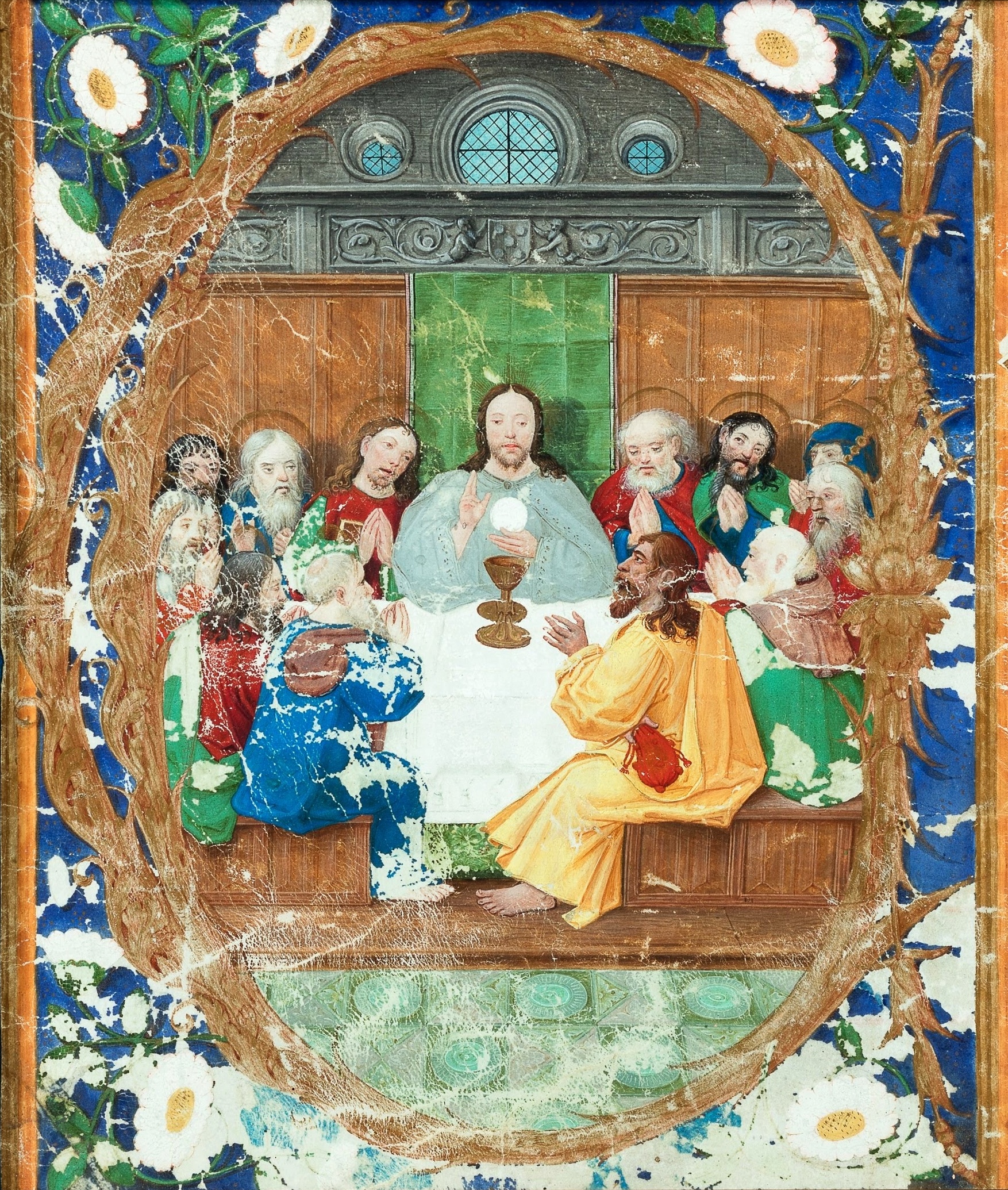
It also appears that this is John's account of Jesus pointing to what was later called the Lord's Supper in which, as Jesus and his disciples were eating the Passover, he took unleavened bread, and after blessing it broke it and gave it to them, and said,
"Take, eat; this is my body." And he took a cup, and when he had given thanks he gave it to them, saying, "Drink of it, all of you, for this is my blood of the covenant, which is poured out for many for the forgiveness of sins. I tell you I will not drink again of this fruit of the vine until that day when I drink it new with you in my Father's kingdom." - Mat 26:26-29 ESV

So we're facing the same dilemma as many of his disciples at Capernaum. When they heard his words, they said, "This is a hard saying; who can listen to it?" - Jhn 6:60 ESV

A hard saying indeed. Who can listen to words that seem literally to say eat my flesh and drink my blood? It just doesn't make sense. There has to be another explanation, a more natural one. Many, many disciples of Jesus right up to the present day try very, very hard to soften his words.

We'll have to pursue these hard words next time.


Monday, June 27, 2011

The Bible, Aliens, UFOs and Flying Saucers

Yesterday afternoon I was messing around with Netflix (I'm a subscriber) and came across the History channel's series on Ancient Aliens. I had seen it before, but decided to take another gander. Fact is, I wasted well over an hour hearing again about supposed flying machines in the days of the ancient Egyptians, Indians and even King Solomon and Ezekiel. My oh my. To think that King Solomon flew around the ancient world on a 'magic carpet' —how intriguing.


Well, anyway, this morning I decided to do some research about all this nonsense about UFO's, aliens from outer space, flying saucers, machines that produced the Manna for the Exodus Hebrews, etc. No conclusions as yet. I simply thought you'd be interested in some of my ruminations. Here are a few:

  • The Manna Machine - these guys wrote a book that describes their imaginary machine used by the wandering Children of Israel to produce Manna during the 40 years of their Exodus. It was driven, by the way, by some type of nuclear energy emanating from the Ark of the Covenant. Wow! Imagine that.


  • The Spaceships of Ezekiel - the unidentified author of this website spends a lot of time debunking the theory that Ezekiel's vision was really about some alien spacecraft landing before his eyes. I think I'll have to come back to this site and take a deeper look.


  • The Bible and Flying Saucers - a Google search brought me to this book by Barry H Downing. A further search for this author revealed that he is a conservative theologian who has a deep interest in the possibility of demonic forces creating the UFO phenomena. I watched an interview about his views. I'm not certain that I really want to buy his 1970 book, but it is interesting to read about it.


  • Dr. Michael S. Heiser - He's the guy interviewing Dr. Downing, it turns out. So I began looking into the scholar of ancient oriental languages who works for the well-known Bible software company Logos. He also has a deep interest in the interface between the Bible and the modern UFOs - aliens from outer space pages on his site and many blogs. He is the author of a wide variety of scholarly papers and books, both non-fiction and fiction. I think I'd like to get to know him.
All in all, the whole search got me back to the Logos homepage and I discovered and installed Vyrso, a software that enables me to read books from Logos, etc. Quite an interesting morning. We'll have to take a deeper look into all this stuff about the Bible, aliens from outer space and UFOs another time. 

Thursday, April 21, 2011

Your Labor Is Not In Vain

John's Gospel is packed with Jesus' teachings during the hours He gathered with His disciples to celebrate the Passover, Thursday evening of Holy Week. All through these teachings He constantly reminded His disciples that He was to die and that they would all desert Him. One of them would even betray Him. In that dark hour He was to fight His final battle with the ruler of this world. Yet even in His death He would not betray them whom He called His friends. So they must abide in Him as branches abide in the vine. His words must be held continually in their hearts. Then they would bear fruit as branches of the grapevine do (John 15:1-8).

Much of this they did not understand. Later, when the Spirit of truth came, He would guide them into the truth. Then they would see and understand: "A little while, and you will see me no longer; and again a little while, and you will see me" (John 16:16).

After Jesus' wonderful prayer to His Father (John 17:1-26), He went with them across the Kidron Valley to the Garden of Gethsemane to pray (John 18:1-2).


In all of this He says nothing about the Lord's Supper, mentioned so prominently in the other three Gospels. Or does He? Not in these chapters, but many feel that John records Jesus' teachings about the Supper in John 6 as He calls Himself the Bread of Life (John 6:48-51). In those verses He calls us all to look back to the story of ancient Israel's 40 years of wandering in the wilderness of Sinai.  All through those years they survived by eating the strange food called manna. The word is a question in Hebrew meaning, "What is it?" They never knew. All they knew was that it was there every morning and that it kept them alive until they entered the land of Canaan (Exodus 16:31-35; Numbers 11:6-9; Joshua 5:12).

The manna was very humbling. It taught them that they were totally dependent upon God's mercy, forgiveness and blessing. His creative Word produced it for them. It was not of their doing. They could not reproduce it nor save it. When they did it became rotten, stank and bred worms (Exodus 16:20). No it was their daily bread, nothing more, nothing less.

So Jesus describes Himself as our Bread of Life. His flesh is food indeed and His blood drink indeed (John 6:55). His flesh is for the life of the world. He who eats of it will not die as did the Israelites in the wilderness. Instead he will live forever! (John 6:51). Hard to believe, but that is the promise.

On this Thursday Christians around the world recall Jesus' institution of His Supper. We do not try to provide logical explanations for the meal. We do not analyze it. That's not its purpose. It is and will ever be a mystery. We eat of this bread and indeed it is bread. We drink of the wine, fruit of the vine. But over these earthly things He speaks His Words, "This is my Body . . . This is my Blood." And we each individually are nourished again for our personal journeys. We are assured that our sins are forgiven, forgotten and removed. So we go forth from the Supper renewed, strengthened for the next leg of our journey. And all the while we are confident that though our bodies will perish another mystery awaits us. This perishable, mortal body will be changed and we will put on immortality. Death will be swallowed up in the victory that is ours in our risen Lord (1 Corinthians 15:51-58):
"Therefore, my beloved brothers, be steadfast, immovable, always abounding in the work of the Lord, knowing that in the Lord your labor is not in vain."